
A ceiling full of stars
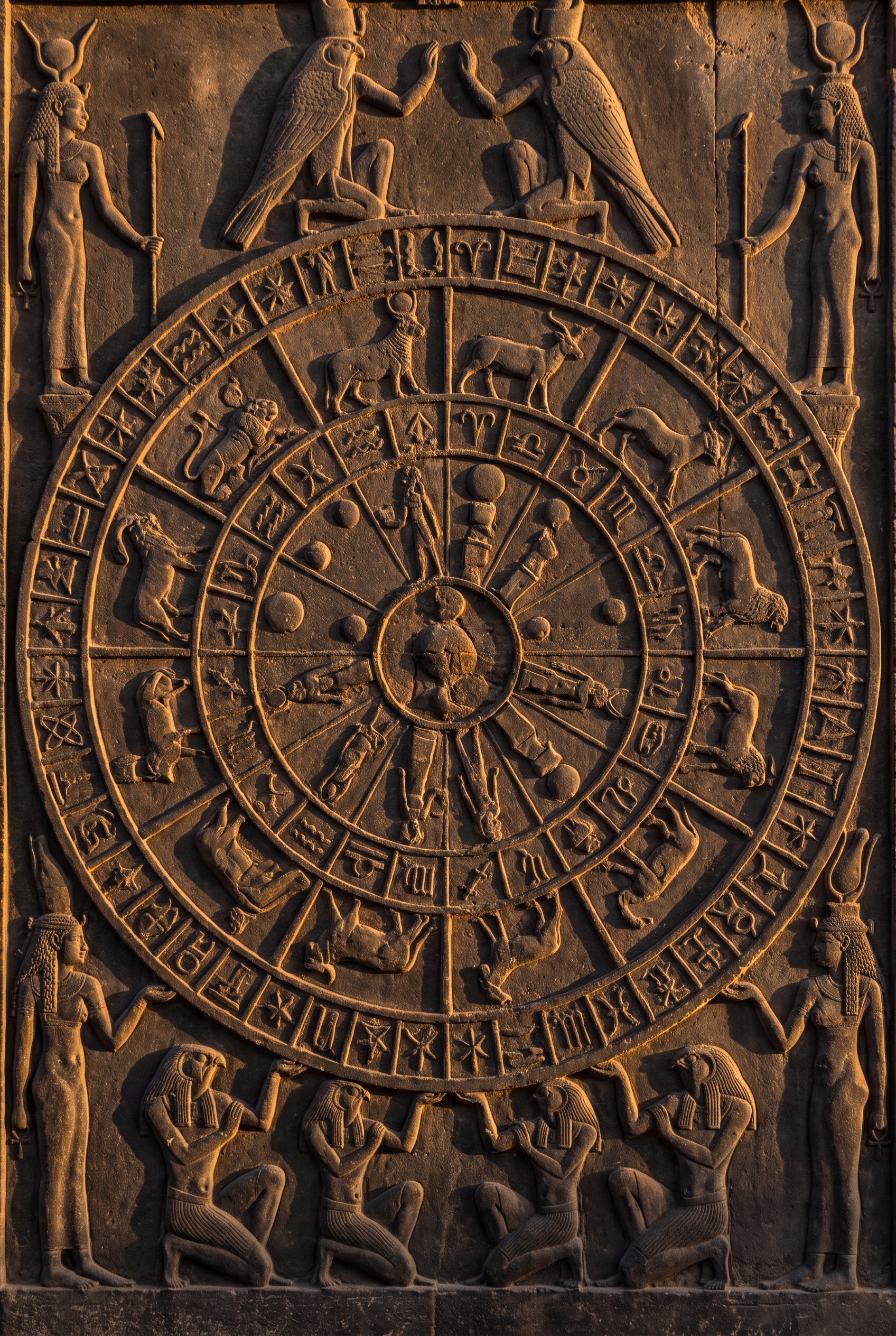
Two thousand years ago, someone in Egypt carved the whole sky into a stone ceiling. It sat in a small chapel to the god Osiris, inside the Temple of Hathor at Dendera, on the Nile.1 The carving is a round disk packed with stars, gods and animals. Today we call it the Dendera zodiac.
It is one of the best-preserved pictures of the sky to survive from the ancient world.2 And it is not in Egypt anymore. It hangs in the Louvre in Paris, because in the 1820s a Frenchman cut it out of the temple with saws and gunpowder.3
How to read the wheel
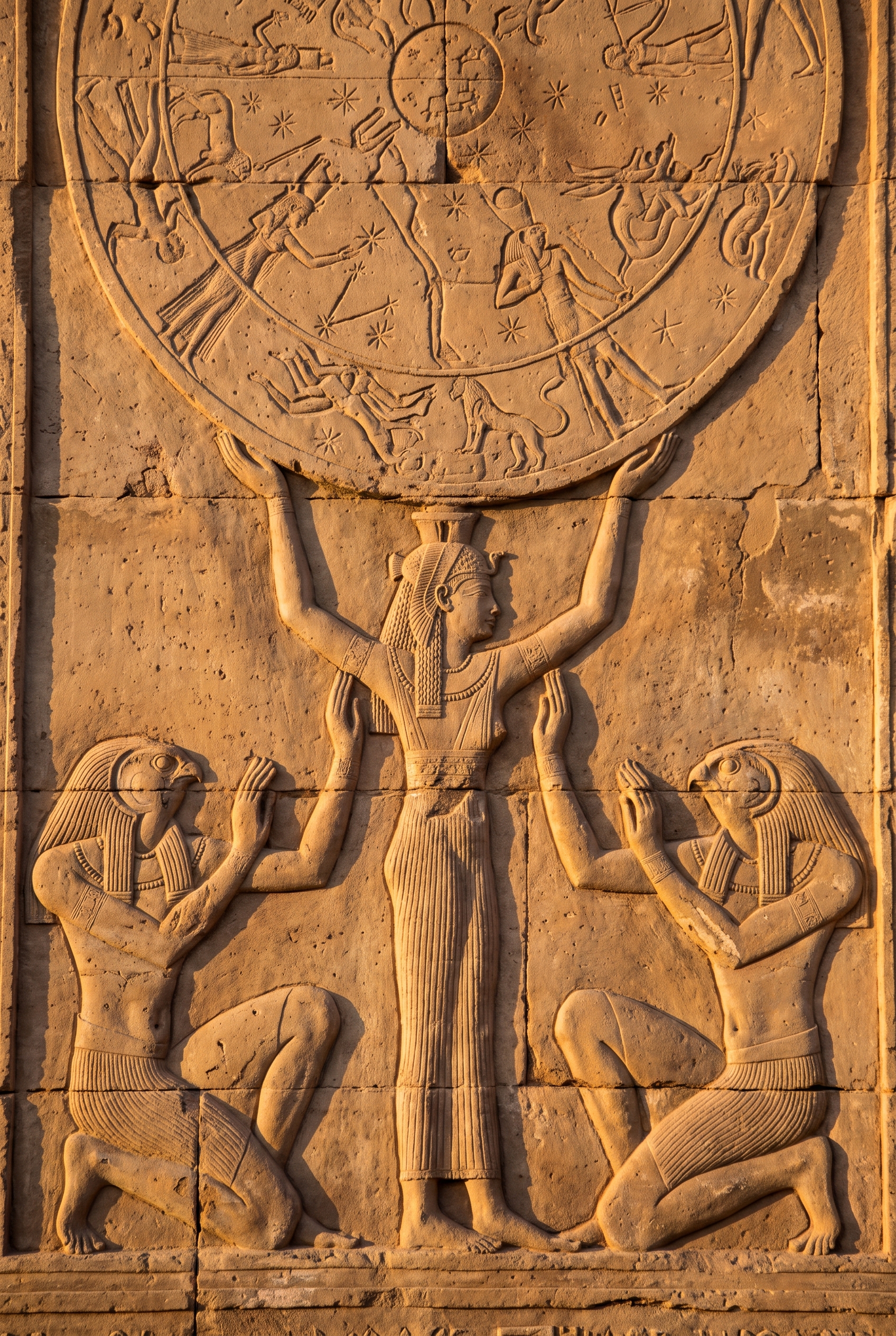
Start at the edges. Four women stand at the corners, holding the sky up. Between them kneel pairs of figures with the heads of falcons, helping.4 The disk they carry is the sky itself.
Inside the disk you will find the twelve signs you already know: the ram, the bull, the twins, the lion, the scales and the rest, walking in a circle. You will also find the five planets the Egyptians could see without a telescope.2
Around the rim march 36 more figures. These are the decans, groups of stars that Egyptians used as a clock. Each one rose in turn through the night, so people could tell the hour. Each one also marked a ten-day “week” of the year.4 This clock is far older than the zodiac on the same ceiling. Star clocks like it were already being painted inside coffin lids around 2000 BC.5
Where the signs came from
The Dendera zodiac is about 2,000 years old. The zodiac itself is much older. To find where it started, you have to leave Egypt and travel east, to Mesopotamia, the land between the Tigris and Euphrates rivers in what is now Iraq.
A bull, a lion and a scorpion show up again and again in the art of the Sumerians, who built the first cities there about 5,000 years ago. The same three animals became some of the oldest star pictures in the sky: Taurus, Leo and Scorpio.6 One historian of the constellations thinks they may be almost as old as that art.6
Other signs grew out of the old gods. Ea, the god who lived in the deep waters, was carved with two streams of water flowing from him. That figure became Aquarius. Ea’s symbol, a goat with the tail of a fish, became Capricorn. It already appears on a seal made in the city of Ur just before 2000 BC.6
Later, the Babylonians wrote the star pictures down. A star list called MUL.APIN, put together around 1000 BC, names the stars along “the path of the Moon,” the band of sky that the Sun, Moon and planets all travel through.67 Some of its names are the ones we still use: the Bull of Heaven, the Lion, the Scorpion, the Scales. Others are a surprise. Aries was the Hired Man, a farm worker. Virgo was the Furrow, the line a plough cuts in a field.6
Then came the big step. The star pictures along that band are all different sizes. Near the end of the fifth century BC, Babylonian astronomers swapped them for twelve equal parts of 30 degrees each, like evenly spaced marks on a ruler.8 Now a position could be given as so many degrees into a sign.8 It is also the zodiac astrologers still use. A tablet dated 419 BC is the oldest known list of all twelve signs.7 The oldest horoscope we have, for a baby born in 410 BC, is Babylonian too.9
The Greeks did not invent the zodiac. They borrowed it, and translated the Babylonian sign names into Greek.7 Within a few centuries, the twelve equal signs were in wide use in Greek astronomy.8
After Alexander the Great, a family of Greek kings, the Ptolemies, ruled Egypt until 30 BC. The zodiac does not appear in Egypt before their time, and it was probably Greeks who brought it.10 Dendera was carved near the end of their rule.110 Its pictures of the signs are close copies of Babylonian ones. A historian who compared them found them almost the same as the figures on Babylonian boundary stones, carved stones that marked who owned a piece of land, made about a thousand years earlier.6
Where Babylon met Egypt
What makes Dendera special is that Egyptian artists drew those borrowed signs in their own way.
Two ways of reading the sky, carved side by side.
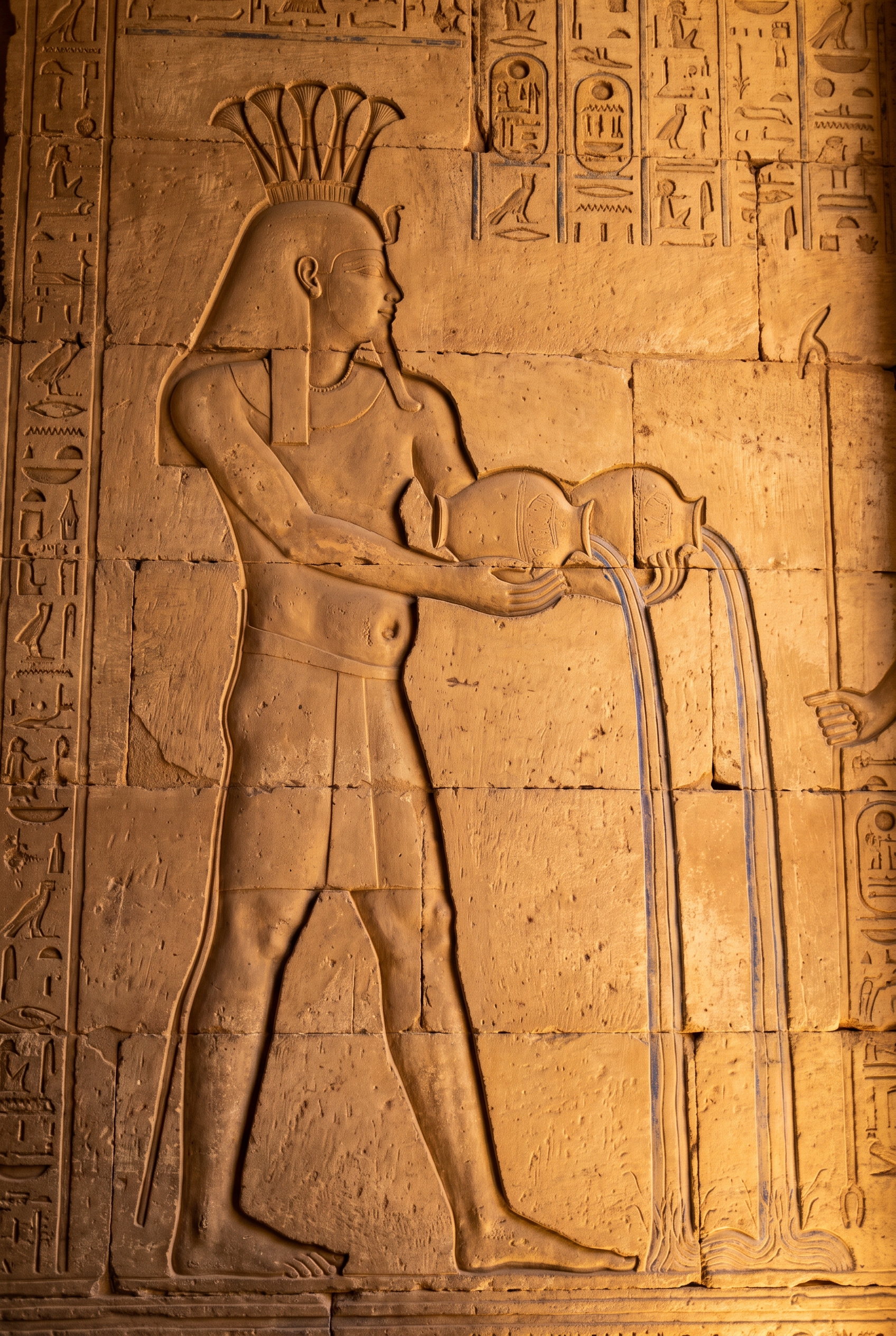
Look for Aquarius. On this ceiling the water-bearer is Hapi, the Egyptian god of the Nile flood, pouring water from two jars.4 So the sign that pours water became the god who brought the river.
That is the real story of this ceiling: two ways of reading the sky, carved side by side. The Babylonian signs sit in the middle. The old Egyptian star clock runs around the edge.
Two eclipses and a date
For a long time nobody agreed how old the zodiac was. The answer turned out to be written in the sky it shows.
The answer turned out to be written in the sky it shows.
The Egyptologist Sylvie Cauville and the astrophysicist Éric Aubourg noticed that the five planets are each placed in a particular sign. That exact arrangement only happens about once every thousand years. It fits the summer of 50 BC, between mid-June and mid-August.1
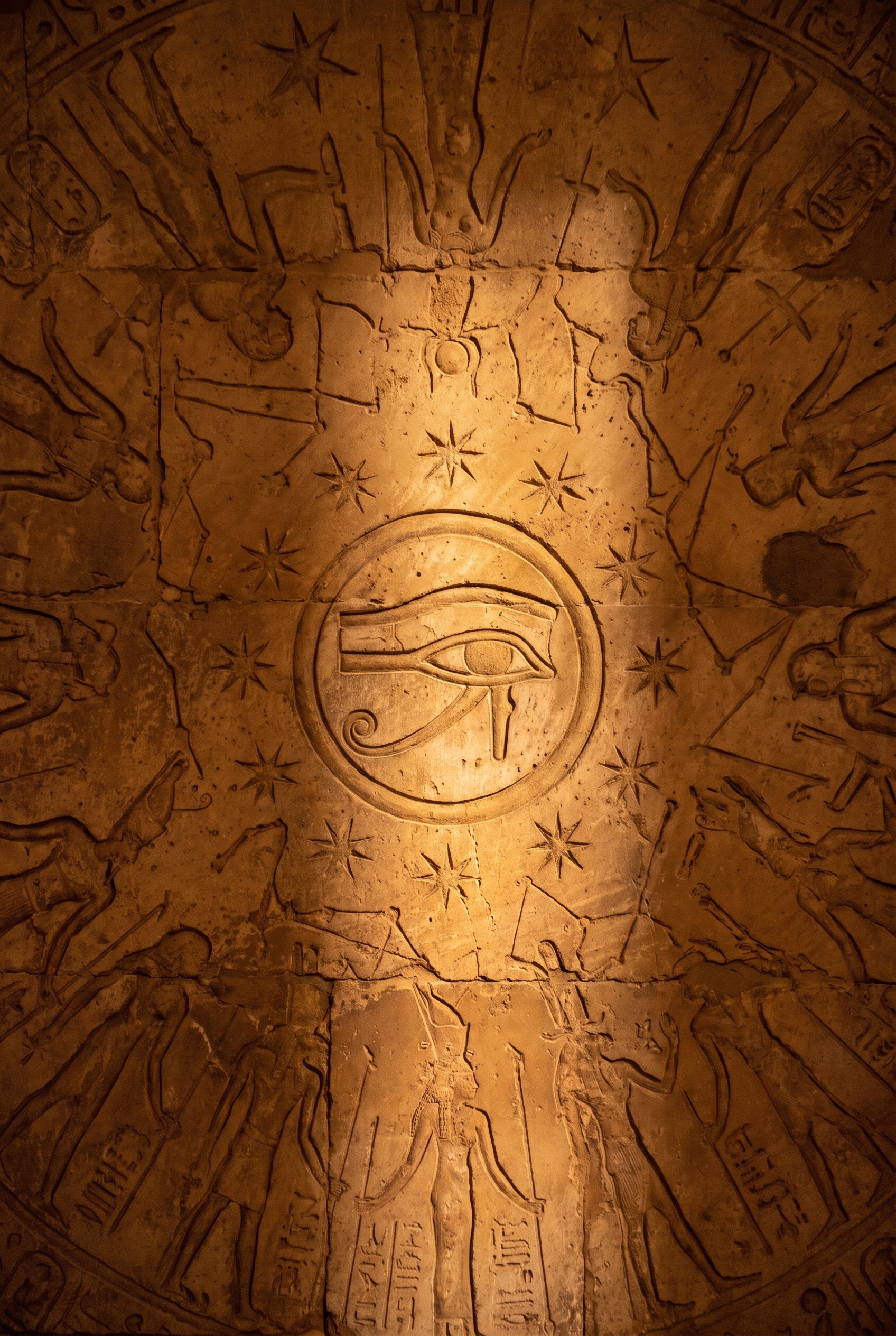
The carving also hides two eclipses. A solar eclipse on 7 March 51 BC is shown as the goddess Isis holding a baboon by its tail. A lunar eclipse on 25 September 52 BC is shown as the Eye of Horus.1
One more clue sits nearby on the ceiling: a royal name ring left empty. The carvers seem to have worked in a gap between kings. That fits the years after Cleopatra’s father died in 51 BC and before she ruled with her young son Caesarion.1 So the zodiac was carved in Cleopatra’s lifetime, in a chapel built to celebrate Osiris rising from the dead.1
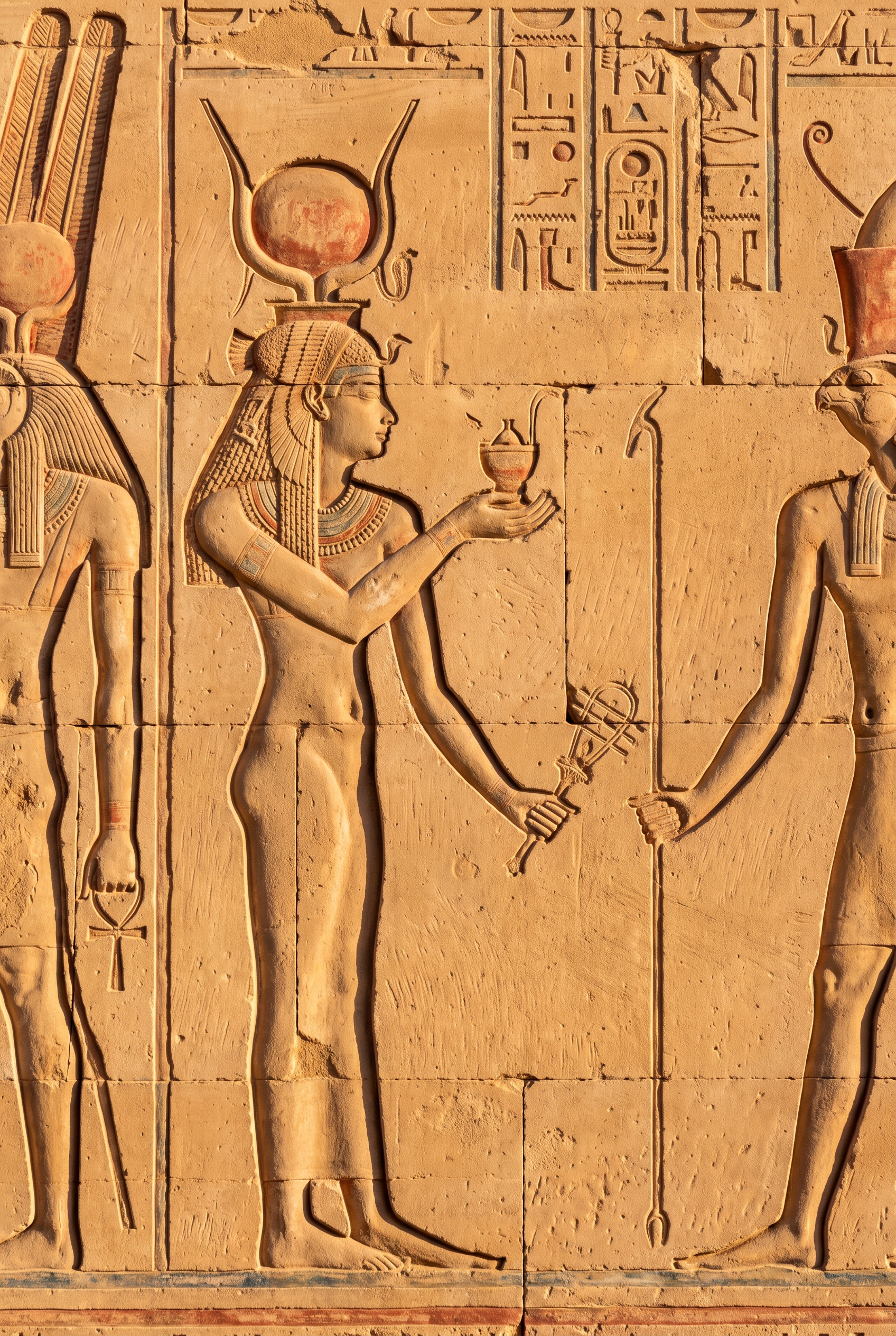
Cleopatra is carved on this temple too. On its south wall, she and her son Caesarion stand making offerings to the gods.11
Saws, jacks and gunpowder
Europe first saw the zodiac through a drawing. In January 1799, a French artist named Vivant Denon was traveling with Napoleon’s army in Egypt. At the Temple of Hathor he came upon the carved sky. He sketched it, and his drawing was published in 1802.3
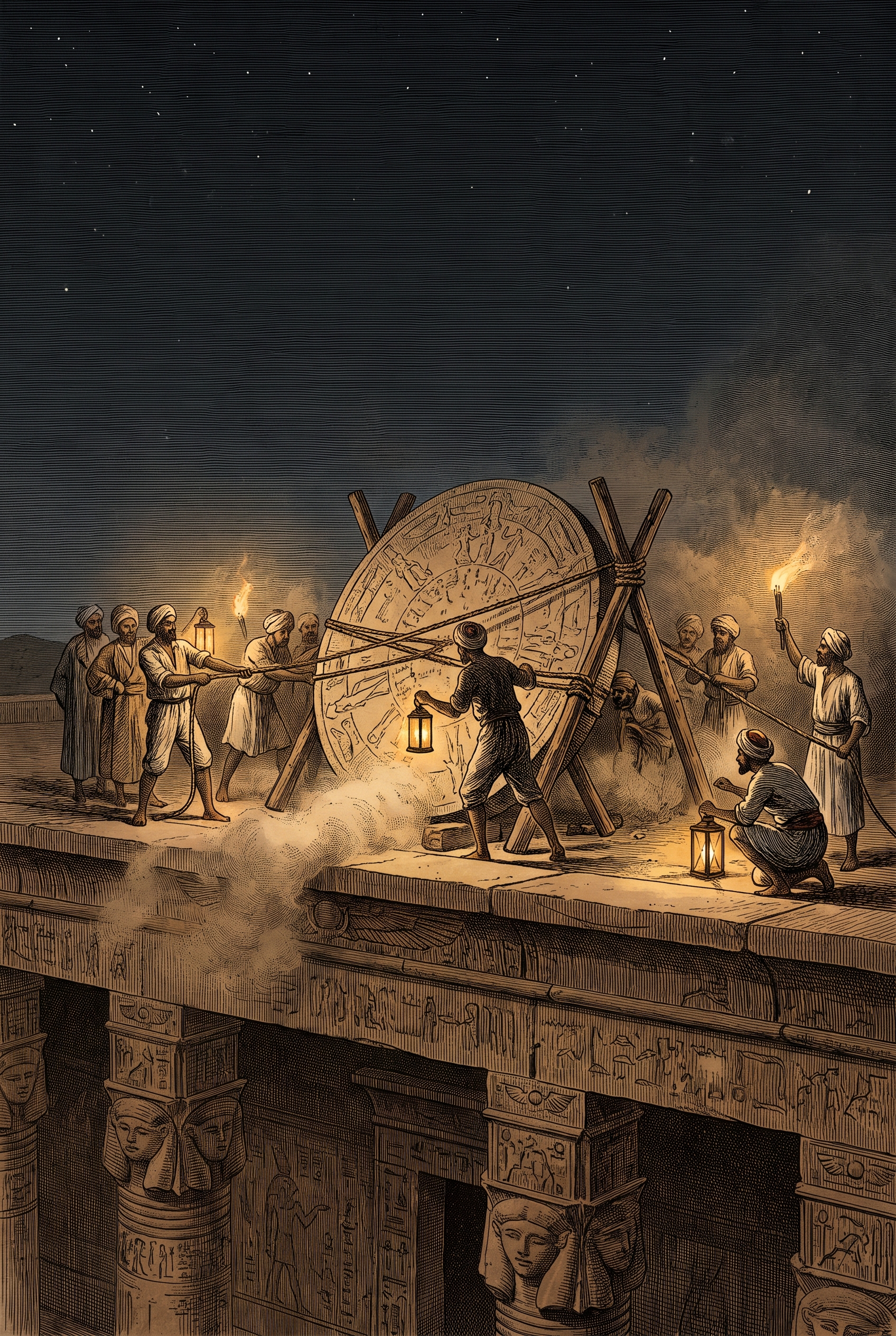
The drawing made the zodiac famous, and that was a problem for the zodiac. In 1821, a Frenchman named Sébastien Saulnier sent an engineer, Claude Lelorrain, to bring it back to France. Lelorrain cut it free with saws, jacks and gunpowder.4 It reached Paris in 1822.4
The drawing made the zodiac famous, and that was a problem for the zodiac.
King Louis XVIII bought it for 150,000 francs, a huge sum, and put it on public display.3 It moved to the Louvre in 1922 and is still there.4 At Dendera, visitors now look up at a faithful copy in its place.12
The fight over its age
In Paris, the zodiac set off a fight. Some scientists thought the star positions proved it was very old. The famous mathematician Joseph Fourier put it at around 2500 BC.4 That was older than the dates many people then gave, from the Bible, for the creation of the world. Some writers used the zodiac to argue against the Church, and religious thinkers pushed back hard.13
The fight was settled by a young scholar who could read the writing on the stone. Jean-François Champollion was cracking the code of Egyptian hieroglyphs in the early 1820s. He argued the date would be found in the inscriptions around the zodiac, not in the stars, and that it came from the time of the Greek kings of Egypt.3 He was right. Today the zodiac is dated to about 50 BC, early in Cleopatra’s reign.1
Still looking up
The people who carved this ceiling were not trying to win an argument about dates. They wanted to keep the sky close. They put the gods, the stars and the turning year into stone, in a room built for a god who comes back to life.
If you’d like to wear a little of that sky, browse the Ancient Egypt collection.
People have been reading messages in the sky for thousands of years. They still arrive, and now one can arrive every morning, written just for you.


Sources
- Jo Marchant, “Mystery of an ancient zodiac” (2010), on the work of Sylvie Cauville and Éric Aubourg. ↩
- Rosicrucian Egyptian Museum, “Greco-Roman Period Monuments: Dendera Zodiac”. ↩
- Linda Hall Library, “The Zodiac of Dendera”, in Napoleon and the Scientific Expedition to Egypt. ↩
- “Dendera zodiac”, Wikipedia, and the scholarship it cites. ↩
- Los Angeles County Museum of Art, “Middle Kingdom Star Clock from a Rectangular Coffin Lid” (2061–1665 BC). ↩
- John H. Rogers, “Origins of the ancient constellations: I. The Mesopotamian traditions”, Journal of the British Astronomical Association 108 (1998). ↩
- Centre for the Study of Manuscript Cultures, University of Hamburg, “The Zodiac: An Inheritance of Mesopotamian Astrology” (2026). ↩
- John M. Steele, “Geminos and Babylonian astronomy”, in Instruments – Observations – Theories: Studies in the History of Astronomy in Honor of James Evans (2020). ↩
- Francesca Rochberg, Babylonian Horoscopes (American Philosophical Society, 1998). ↩
- Owen Jarus, “Ancient zodiac paintings on Egyptian temple see the light of day after 2,200 years”, Live Science (2023), quoting Egyptologist Christian Leitz of the University of Tübingen. ↩
- Institute of Egyptian Art & Archaeology, University of Memphis, “Dendara: Temple of Hathor”. ↩
- Le Routard, “Dendérah” (in French). ↩
- Jed Z. Buchwald and Diane Greco Josefowicz, The Zodiac of Paris (Princeton University Press, 2010). ↩