
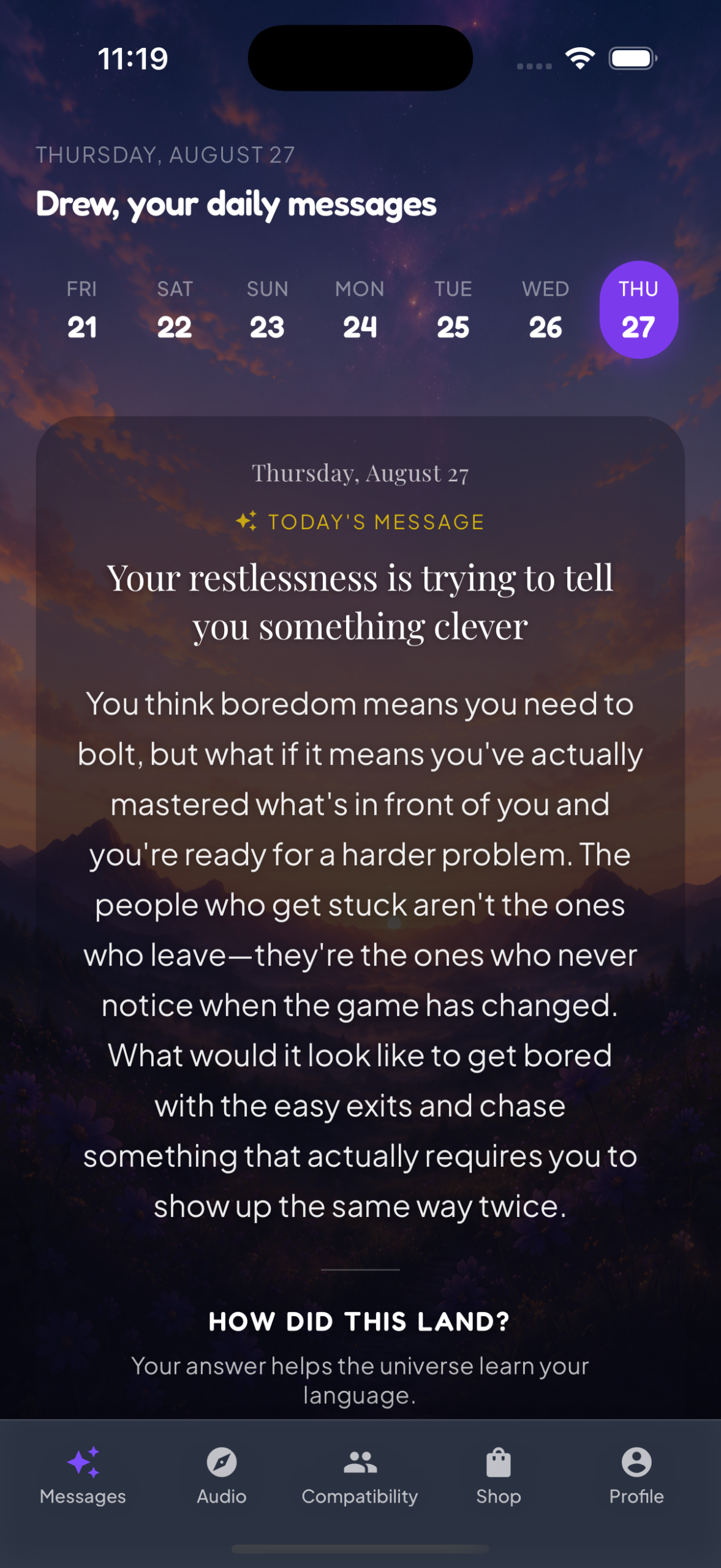
Most apps talk at you. This one listens.
Astra Solara is a quiet daily practice. Every morning, one message arrives — written for you. Not a horoscope pasted from a list. Not a quote of the day that ten million other people got too. One message, made from who you are and where things stand today, in plain words. No star charts to read. No jargon to learn. You don’t need to know anything about astrology to use it — you just need to be curious about yourself.
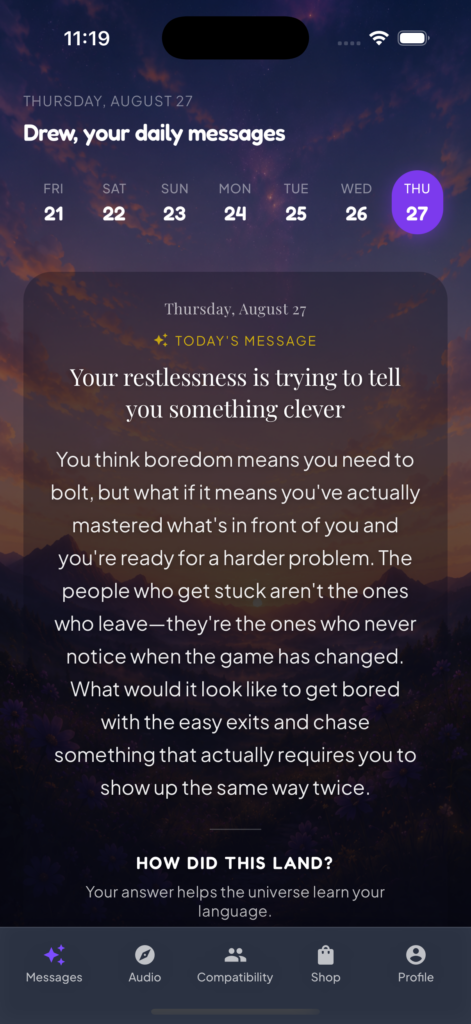
You get to answer
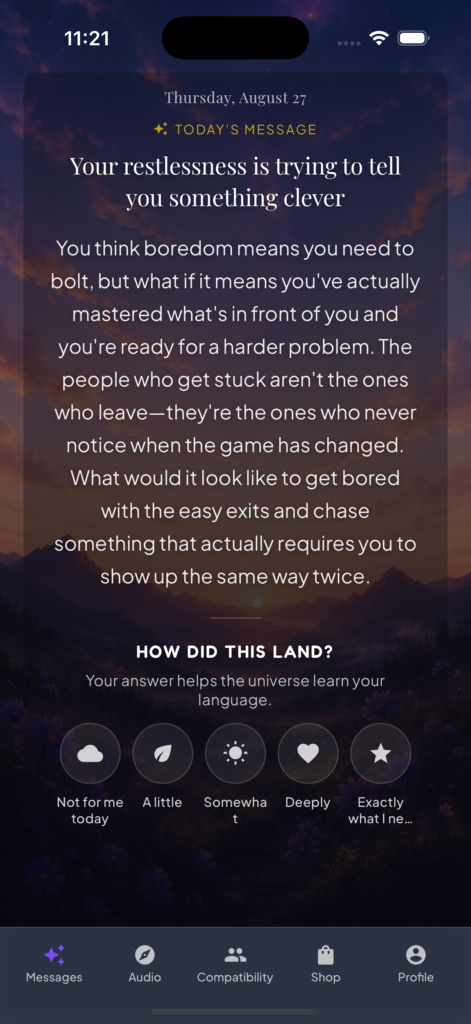
Here’s the part that makes it different: when you read your message, you answer it.
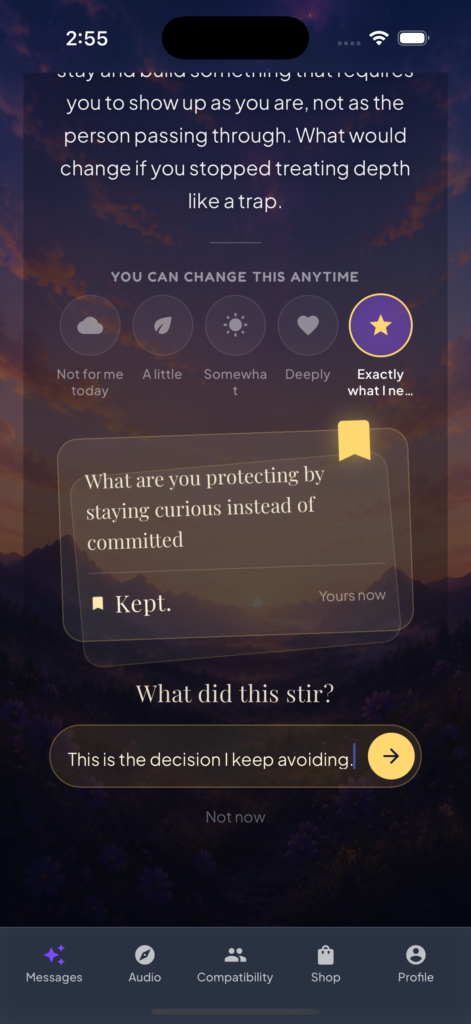
Not with a review. With the truth. Five simple answers, from “Exactly what I needed” all the way down to “Not for me today.” And that last one matters — some days a message just isn’t yours, and saying so is a real answer, not a rejection. The app treats it that way.
Your answer isn’t feedback disappearing into a void. It’s you, talking back. The app remembers what landed — not what’s popular, not what’s trending. What found you.
It keeps what matters
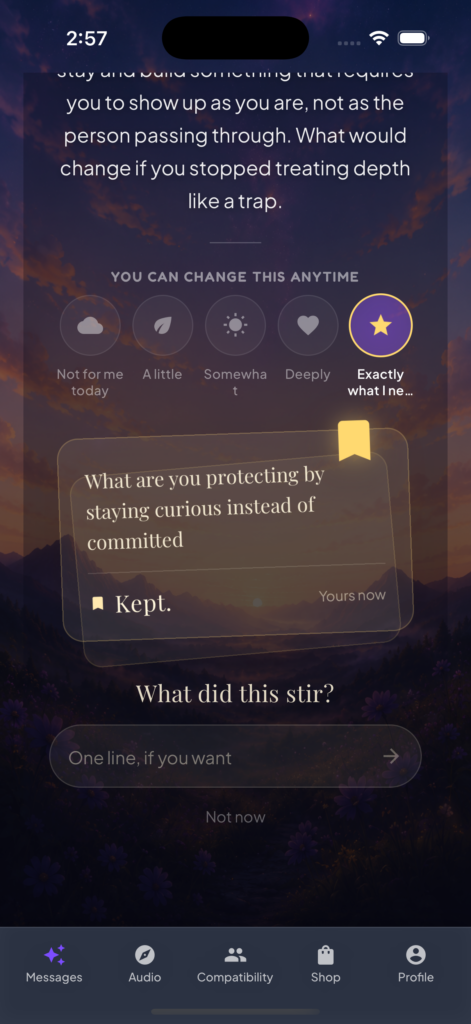
When a message really lands, it’s kept. Saved. Yours.
You can respond
From your very first answer, you’re building something: a small collection of the words that met you at the right moment. Most of what we read disappears an hour later. This doesn’t.
And you can go and read it. Your kept messages live in one place — the whole collection, in order, with whatever you wrote beside each one.
And if a message stirs something, you can write one line back — what it touched, what it reminded you of. Just for you. Nobody sees it. It’s the difference between reading something and actually sitting with it for a second. That second is the whole point.
Sometimes, it comes back
This is the part people don’t expect.
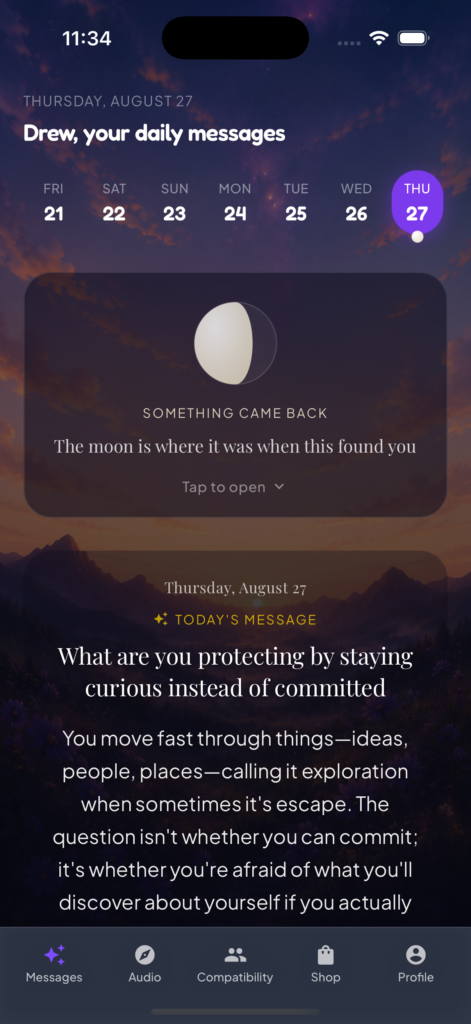
Weeks later — when the moon has come all the way around to where it was the day a message first found you — that message can return. Sealed, like a letter. You open it and there it is: the words, the day, and if you wrote something back then, your own words too.
Then one small question: “And now?”
Maybe it still lands. Maybe it lands deeper. Maybe you’ve moved past it — and noticing that you’ve moved is its own kind of gift. Nothing else in your day asks you that question. This does, gently, on the sky’s schedule instead of a marketing calendar.
And the whole thing is kept as one thread: the message, your answer, the line you wrote at the time, and the day it came back — so you can follow a single thought from the morning it arrived to the morning it returned.
You’re not the only one listening
After you answer, one quiet line tells you something small and true: how many other people answered today.
Not a leaderboard. No names, no profiles, nothing to scroll. Just — “A quiet circle today. You and four others answered.” Some days that number is small. Some days it isn’t. It’s the real number.
It’s a strange comfort, and an honest one: whatever the message asked of you this morning, you weren’t the only one sitting with it. Same sky, same question, a few hundred other people somewhere deciding what it meant to them.
A few smaller things you’ll notice. The five answers each feel different in your hand now — a light tap for “not for me today,” something warmer for “exactly what I needed.” And if you’ve turned on Reduce Motion on your phone, the app finally listens to that too: the same words, the same keeping, without anything moving.
Sunday looks back
Your weekly audio reading can end somewhere it didn’t before: a short passage about the week just gone — the messages that landed, and anything you wrote beside them.
It’s seven days, not a verdict on you. And it isn’t there every week. A quiet week leaves nothing to look back on, so it says nothing — and if the passage doesn’t come out well enough, it’s left out rather than padded.
What’s still coming
A few honest gaps, so you know what you’re getting today.
Further out, a look back at your year: the words that found you, and how you changed while they did.
And quietly, underneath all of it, the writing keeps getting better. Not more messages — better ones, at better moments.
What it doesn’t do
It doesn’t predict your future. It doesn’t tell you who you are — you’re the expert on that. It doesn’t want you staring at your phone all day; one honest minute in the morning is enough. And it doesn’t turn your answers into ads, or show your reflections to anyone. What you write is yours.
The app’s job is simpler than all that: hand you something true to think about, remember what mattered to you, and give it back when the time is right. A mirror, not a fortune teller.
Who it’s for
People who like a little ritual in the morning. People who journal, or always meant to. People who want to feel less like they’re scrolling through life and more like they’re noticing it. And people who are curious what paying attention to themselves might turn up.
You can also bring the people you love into it — the app can look at you and someone close to you together, and offer a warm, honest picture of how you fit. That one is a separate purchase, one report at a time, not part of any subscription.
Try it
The daily message is free. So are your answers, the messages you keep, the lines you write beside them, and the quiet count of everyone else answering. Answer a handful of mornings and feel the difference between an app that broadcasts and one that pays attention.
The weekly audio reading is free for your first two weeks; after that it’s part of the subscription. So the question waiting at the end isn’t whether the whole thing was worth buying. It’s only whether you want the Sunday audio as well.
That’s an easier question.