
Is the Veil Really Thinnest on Halloween? The Story Behind It
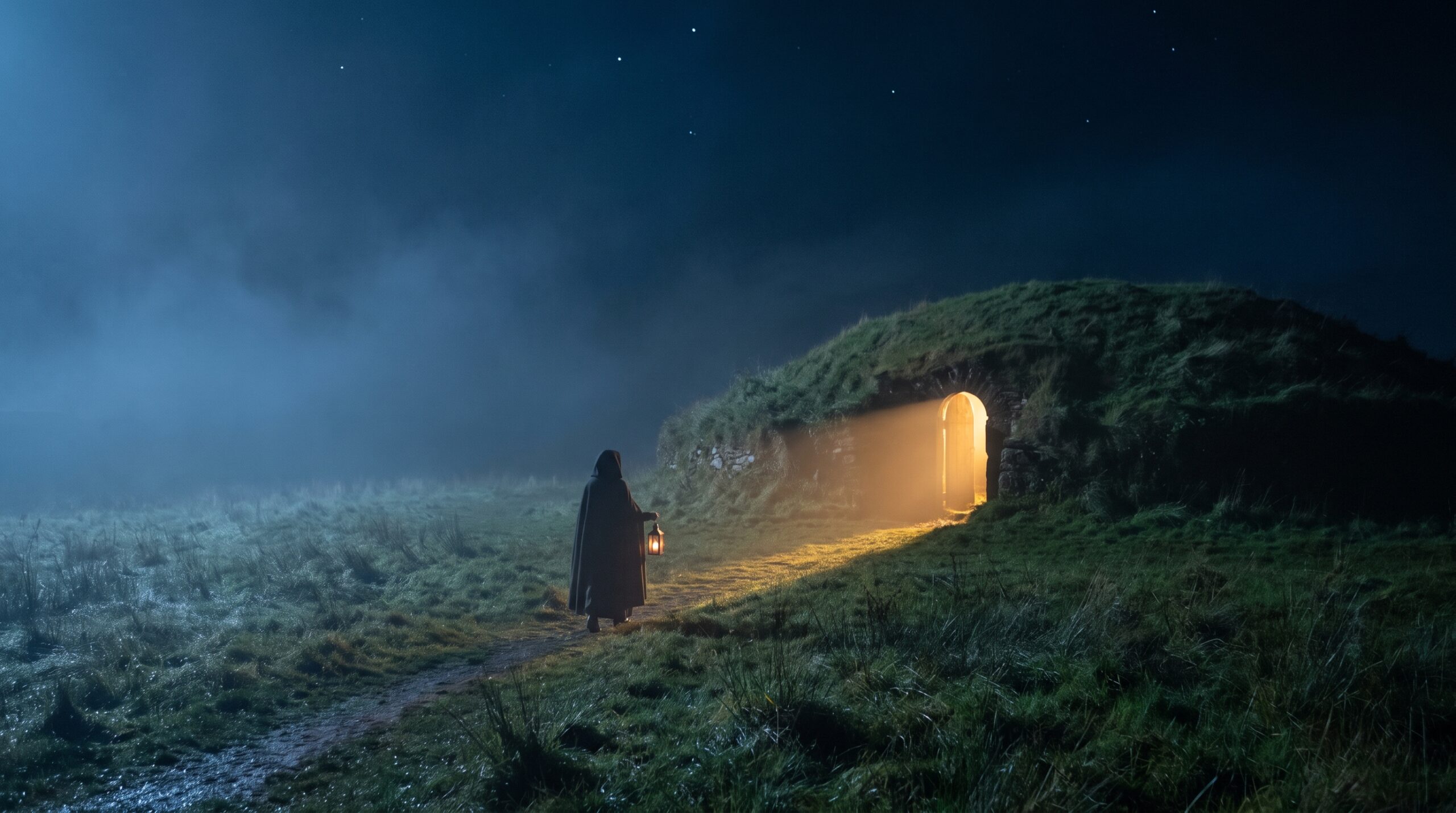
Every October, the same spooky sentence turns up all over your feed: the veil between the living and the dead is thinnest on Halloween.
The oldest Halloween stories would like a word. In them, there’s no veil. There’s a door. In a hill. And a dead man standing next to it who would really, really like a drink.
A Dead Man Who Wanted a Drink
It’s Halloween night at Rath Cruachan, the royal fort of Queen Medb and King Ailill in the west of Ireland. Dinner is cooking. Outside, two prisoners hang from the gallows, hanged the day before.[^meyer]
This is, apparently, the perfect moment for party games. King Ailill announces a dare: whoever goes out in the dark and ties a twig around the foot of one of the dead men can name his own prize.[^meyer]
A young warrior named Nera takes it.[^meyer] Somebody always does.
Three times the twig springs off the dead man’s foot. Then the dead man speaks up and tells Nera he’s doing it wrong.[^meyer]
You’re failing at a simple job, and the corpse offers notes.
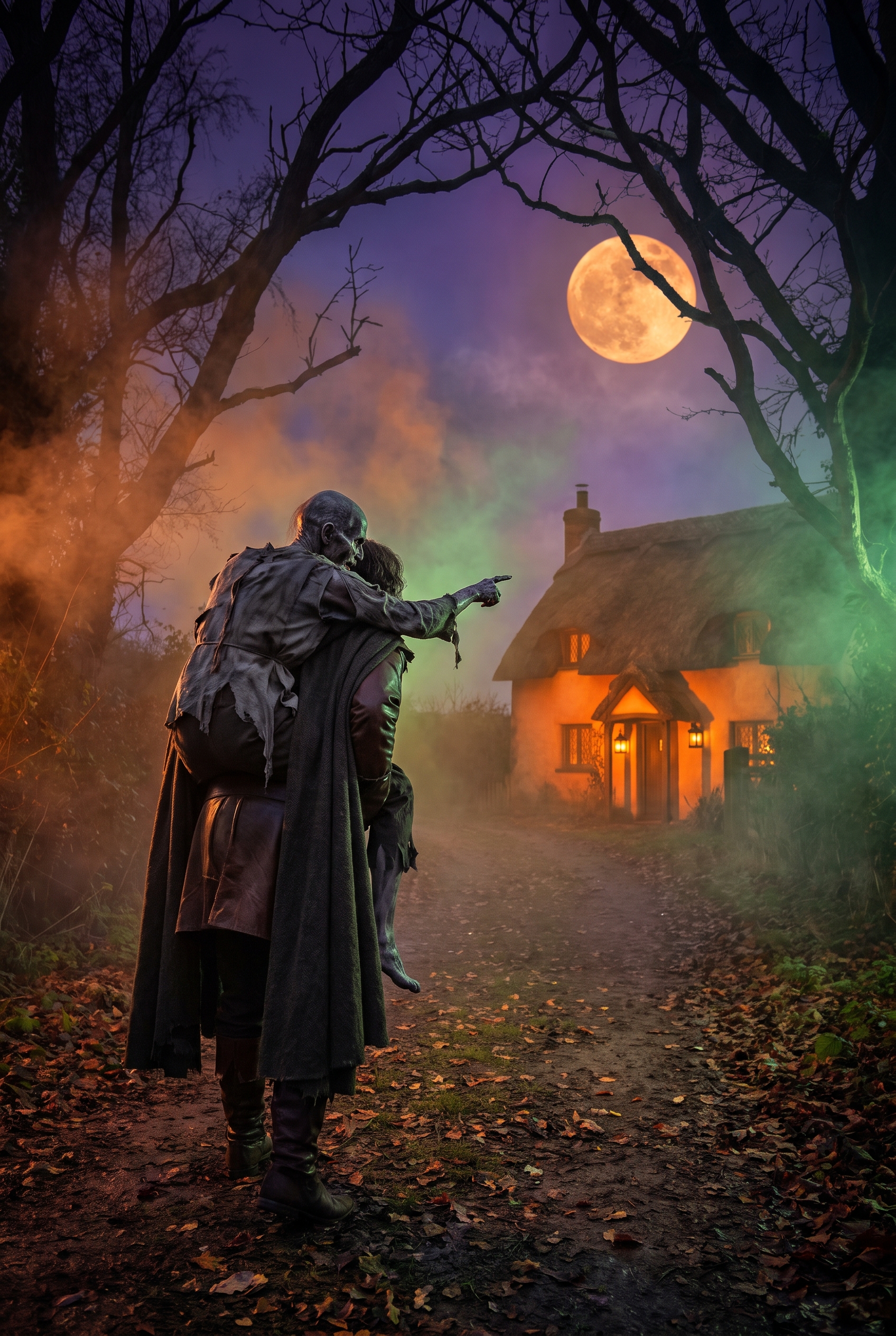
Then he asks for a favor. “Take me on thy neck,” he says, “that I may get a drink with thee. I was very thirsty when I was hanged.”[^meyer]
So Nera gives a dead man a piggyback ride through the Halloween dark, on a beverage run.
This is the opening of The Adventures of Nera, an old Irish tale that the scholar Kuno Meyer put into English in 1889.[^meyer] Meyer used the word “Halloween” in his translation. The Irish story itself says Samhain (you say it “SOW-in”), the feast at the start of winter that Halloween grew from.[^wiki][^oneill]
Nobody in this story mentions a veil. The dead man has other priorities.
The Night the Hills Opened
The pair try three houses. The first is surrounded by a lake of fire, because its fire is never banked down at night. The second is surrounded by a lake of water, because it never leaves a washing tub or a slop pail out overnight.[^meyer]
The third house is not so tidy. It has tubs of water and a slop pail on the floor. The dead man drinks from the tubs, then spits the last sip at the people in the house, and they all die.[^meyer]
The story stops right there to state the moral: it is not good to keep a washing tub, an unbanked fire or a slop pail in the house after bedtime.[^meyer] So the first lesson of the oldest Halloween story is, essentially, do your chores.
Then Nera, ever the gentleman, carries the dead man back to the gallows.[^meyer] Door-to-door service, both ways.
When Nera gets back to the fort, he finds it burned, and an army from the otherworld marching away into the hill at Cruachan. He follows them in.[^meyer]
Inside, a woman explains that what he saw was a vision of the future. That army will attack next Samhain, unless someone warns the fort. “They will come on Halloween next,” she says, “for the fairy-mounds of Erinn are always opened about Halloween.”[^meyer]
Ireland is dotted with ancient grassy mounds. The stories say they are the halls of otherworld people, and on Samhain their doors open.[^wiki]
Not a veil. A door.
Nera stays inside for what feels to him like three days and three nights. But back at the fort, the woman tells him, his friends “are still round the same cauldron,” and the food has not yet come off the fire.[^meyer]
The otherworld bends time. Apparently so does that kitchen.
To prove where he’s been, he brings back flowers of summer in the middle of winter: wild garlic, primrose and golden fern.[^meyer]
Hell Has a Front Door
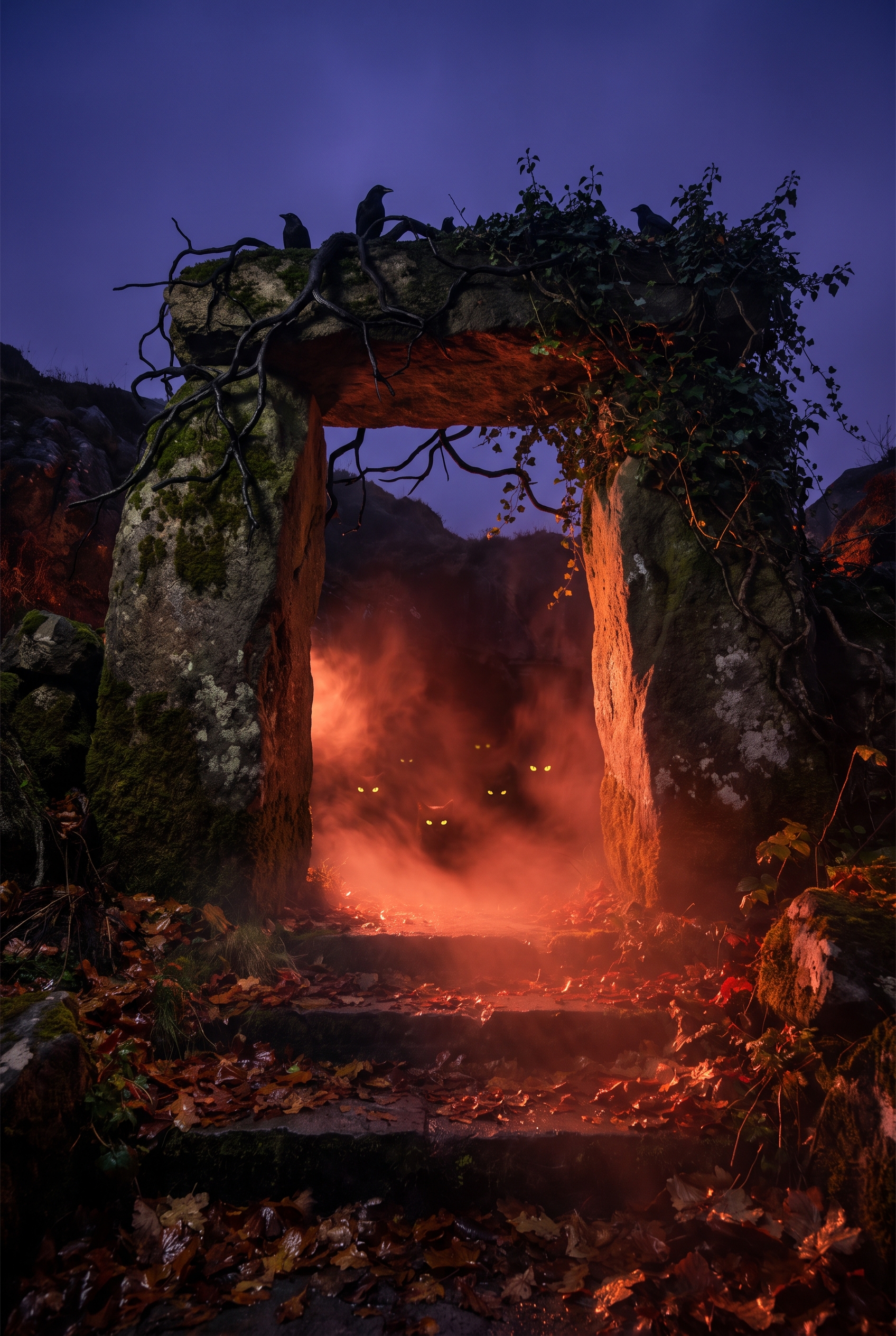
You can still visit Cruachan. It’s called Rathcroghan now, and in one of its fields is a narrow cave named Oweynagat. The name means “cave of the cats.”[^natgeo_cave]
Legend calls it the gate to hell. On Samhain, as National Geographic puts it, “a whole host of fearsome otherworldly beasts emerged to ravage the surrounding landscape.”[^natgeo_cave]
So yes: hell has a front door, and it’s in a field.
Getting to it is refreshingly low-key. You hop a fence, walk through a field, and peer into a narrow passage.[^natgeo_cave] No turnstile at the cave mouth. No “I Survived the Gates of Hell” T-shirts.
Archaeologist Daniel Curley, who knows the site well, would like to keep it that way. “We want sustainable tourism,” he says, “not a rush of gimmicky Halloween tourism.”[^natgeo_cave]
Fair enough. Hell has managed without a gift shop so far.
How the Door Became a Veil
So where did the veil come from? First, the Victorians got involved.
In the late 1800s, the scholars John Rhys and James Frazer decided Samhain had been the “Celtic New Year.” Frazer added that it was an ancient festival of the dead, which the Church later turned into All Saints and All Souls.[^wiki]
The historian Ronald Hutton has since looked at the same old records and called the New Year evidence flimsy.[^wiki] (That’s academic for “nice story, where’s your proof?”)
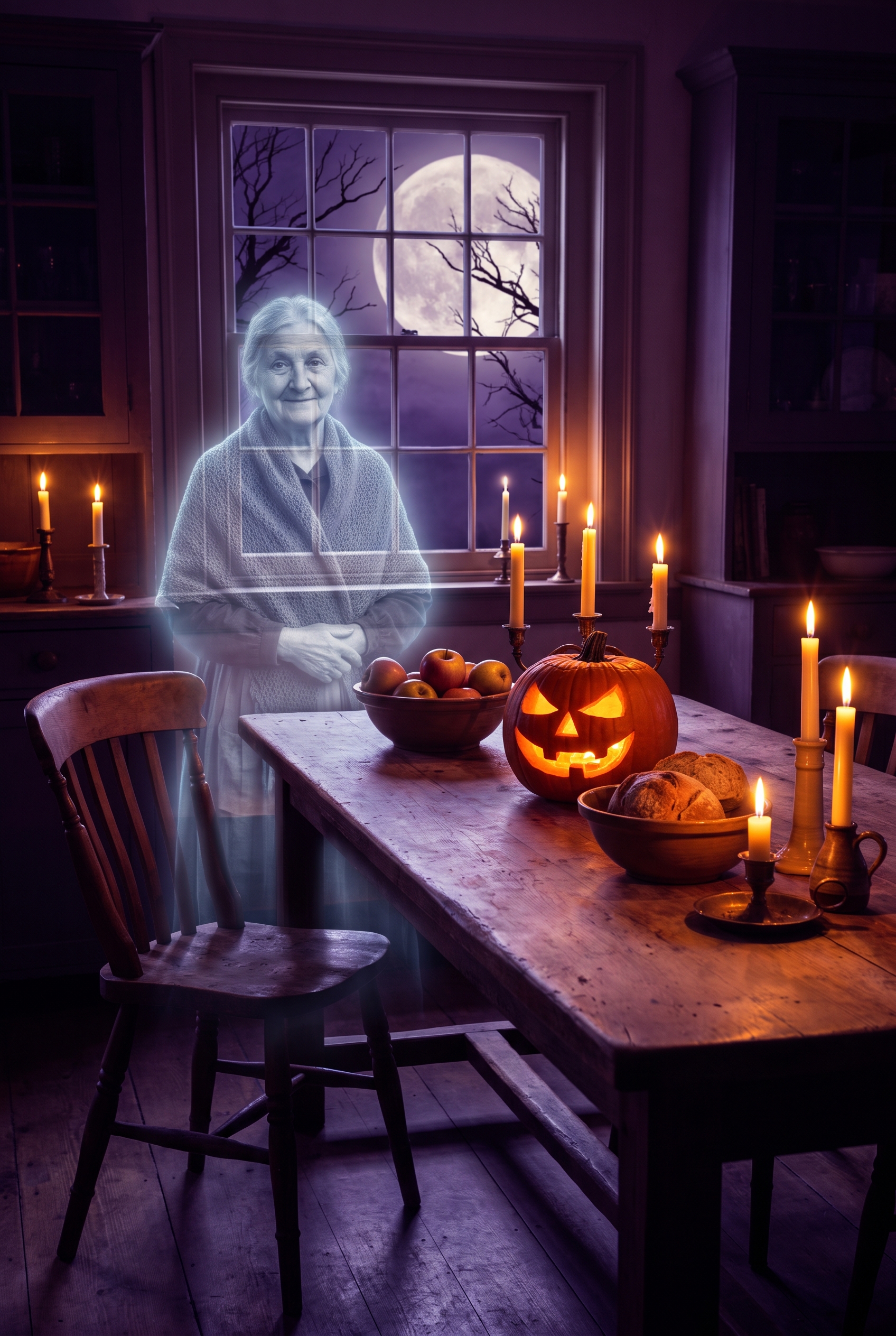
Meanwhile, ordinary families were busy being good hosts to ghosts. In later centuries, people believed the souls of dead relatives came home at Samhain looking for a welcome, and they set places for them at the dinner table.[^wiki]
Grandma’s back, and somebody saved her a seat. Honestly, that’s lovely.
The word “veil” comes from modern paganism. Wiccans, who celebrate Samhain as one of the festivals of their year, say the veil between this world and the afterlife is at its thinnest then.[^wiki] The phrase caught on so well that scholars now borrow it to describe the old belief too.[^oneill]
The old storytellers would have recognized the feeling. They just pictured a door instead of a curtain.
A Turnip With a Face
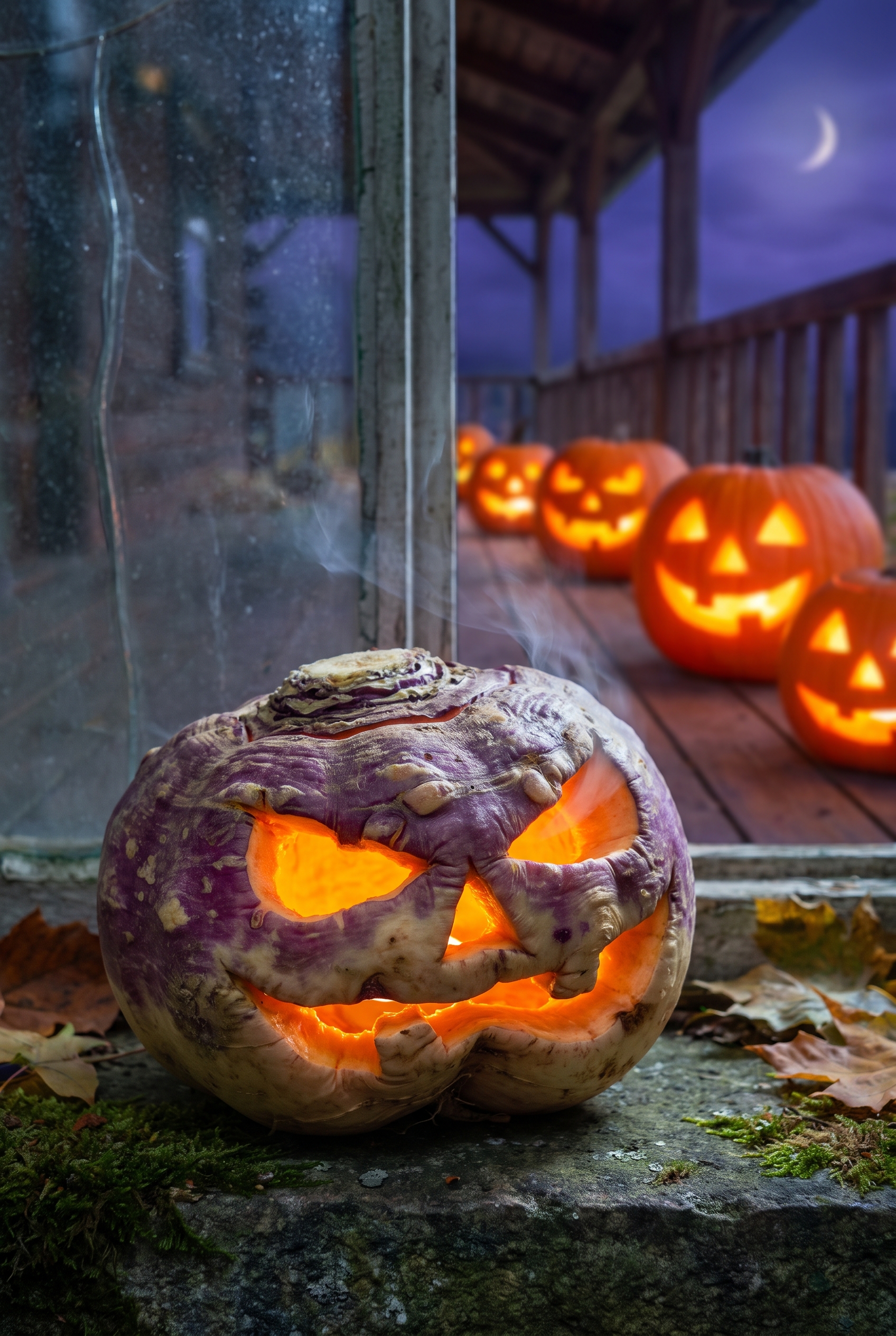
The jack-o’-lantern started in the same part of the world. It just started a lot uglier.
At Samhain, people carved frightening faces into root vegetables like beets, potatoes and turnips.[^natgeo_jack] The National Museum of Ireland has a plaster cast of a carved turnip lantern from the early 1900s.[^natgeo_jack] If you’ve ever wondered what a vegetable looks like when it’s holding a grudge, that’s the one.
The name comes from Stingy Jack. There are dozens of versions of his story, but in many of them he tricks the devil twice.[^natgeo_jack] Once is a clever trick. Twice means the devil really needs to start reading the fine print.
When Irish families moved to North America in the 1800s and early 1900s, they found pumpkins, which were much easier to carve than a turnip.[^natgeo_jack] Anyone who has tried to hollow out a raw turnip with a spoon understands this decision completely. The first known picture of a pumpkin jack-o’-lantern was most likely printed in Harper’s Weekly in 1867.[^natgeo_jack]
Messages From the Other Side
A door in a hill. A light in a turnip. A place set at the table for someone who isn’t there.
And back at the fort, dinner is probably still not ready.
People have always watched for messages from somewhere beyond: in the hills, in the dark, in the sky. Now one arrives every morning, written just for you.


[^meyer]: Kuno Meyer (tr.), The Adventures of Nera, Revue Celtique 10 (1889). [^wiki]: Wikipedia, Samhain (accessed 2026). [^oneill]: Pamela O’Neill, Samhain: the true, non-American origins of Halloween, The Conversation (2025). [^natgeo_cave]: Ronan O’Connell, Inside Ireland’s ‘gate to hell’ that birthed Halloween, National Geographic (2021). [^natgeo_jack]: Blane Bachelor, The twisted transatlantic tale of American jack-o’-lanterns, National Geographic (2020).