
The Comet Stitched Into the Bayeux Tapestry (and the Meteors It Leaves Every October)
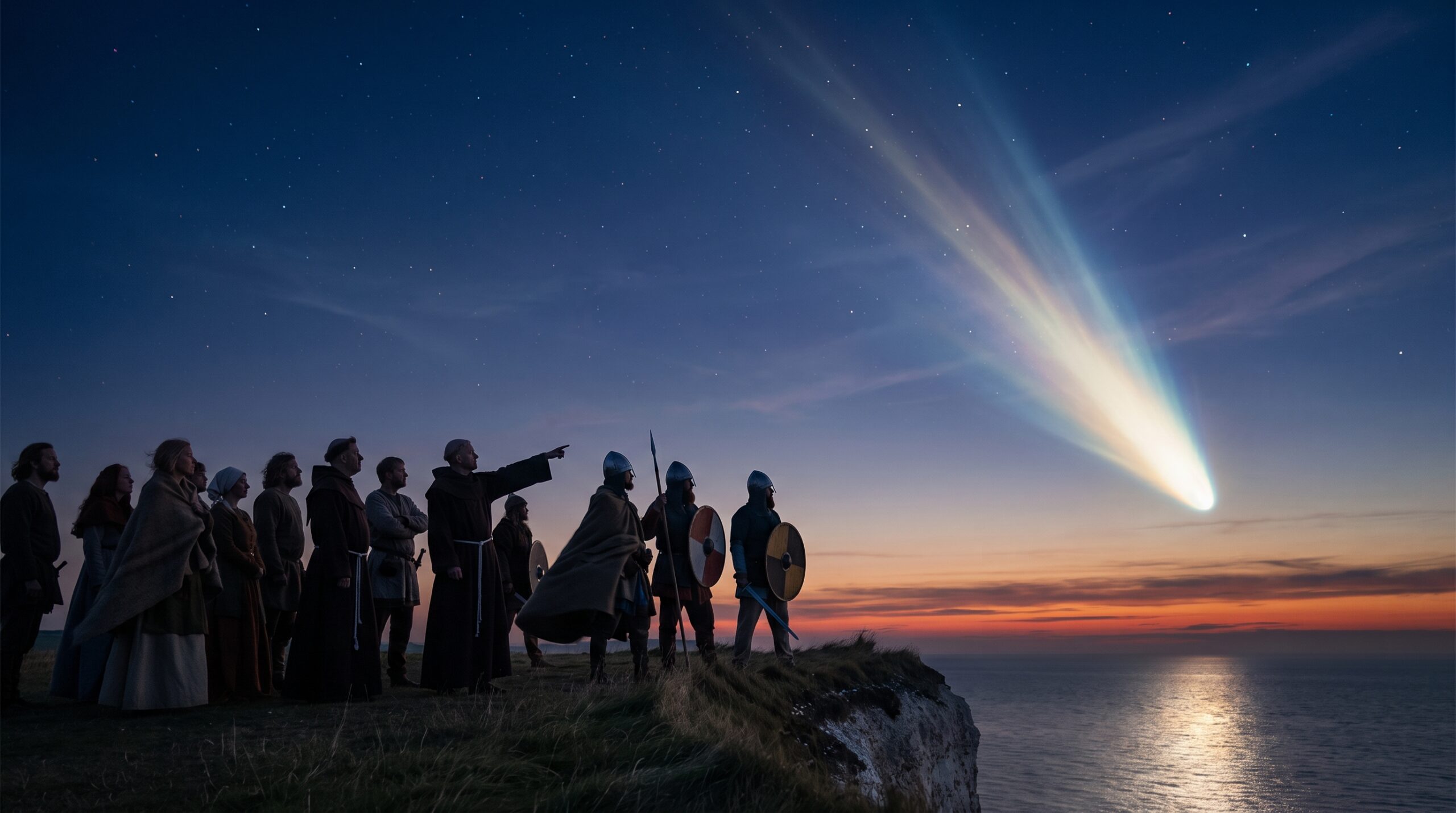
Men pointing at the sky
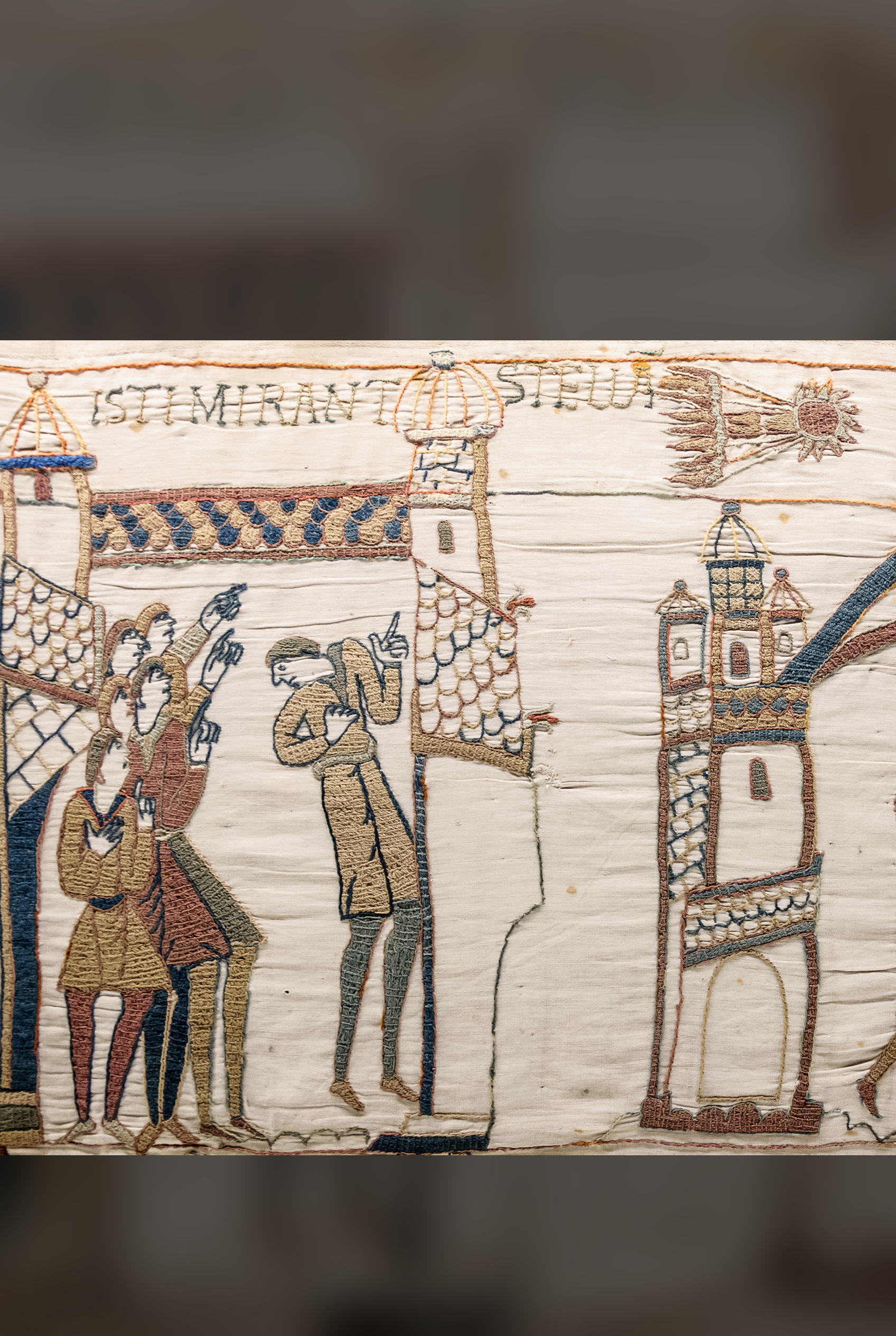
Somewhere along the Bayeux Tapestry, a 70-meter (230-foot) strip of embroidery, a group of men are pointing at the sky. Above them hangs a star with a long, fiery tail. Stitched beside it are three Latin words: ISTI MIRANT STELLA, “these men marvel at the star.”[^lewis]
It’s April 1066. Nobody in England knows yet that by Christmas they’ll have a new king, a Norman one.[^bayeux] (Spoiler: he’s coming in the next few scenes.)
But everyone can see the comet. Before long, people will be saying it meant a kingdom was about to change hands.[^lewis]
That star is Halley’s Comet.[^bayeuxonline] It’s the same comet that will swing past Earth again in 2061, and its dust falls as shooting stars every October.[^nasahalley]
Despite its name, the Bayeux Tapestry is an embroidery: pictures stitched in dyed wool onto linen cloth, about half a meter high.[^bayeux] (That’s 70 meters of needlework. Think about that the next time you sew on a button.)
It was made around 1072 to 1077, probably by English embroiderers working from drawings made in Canterbury.[^bmexhibit]
A comet in the wrong place
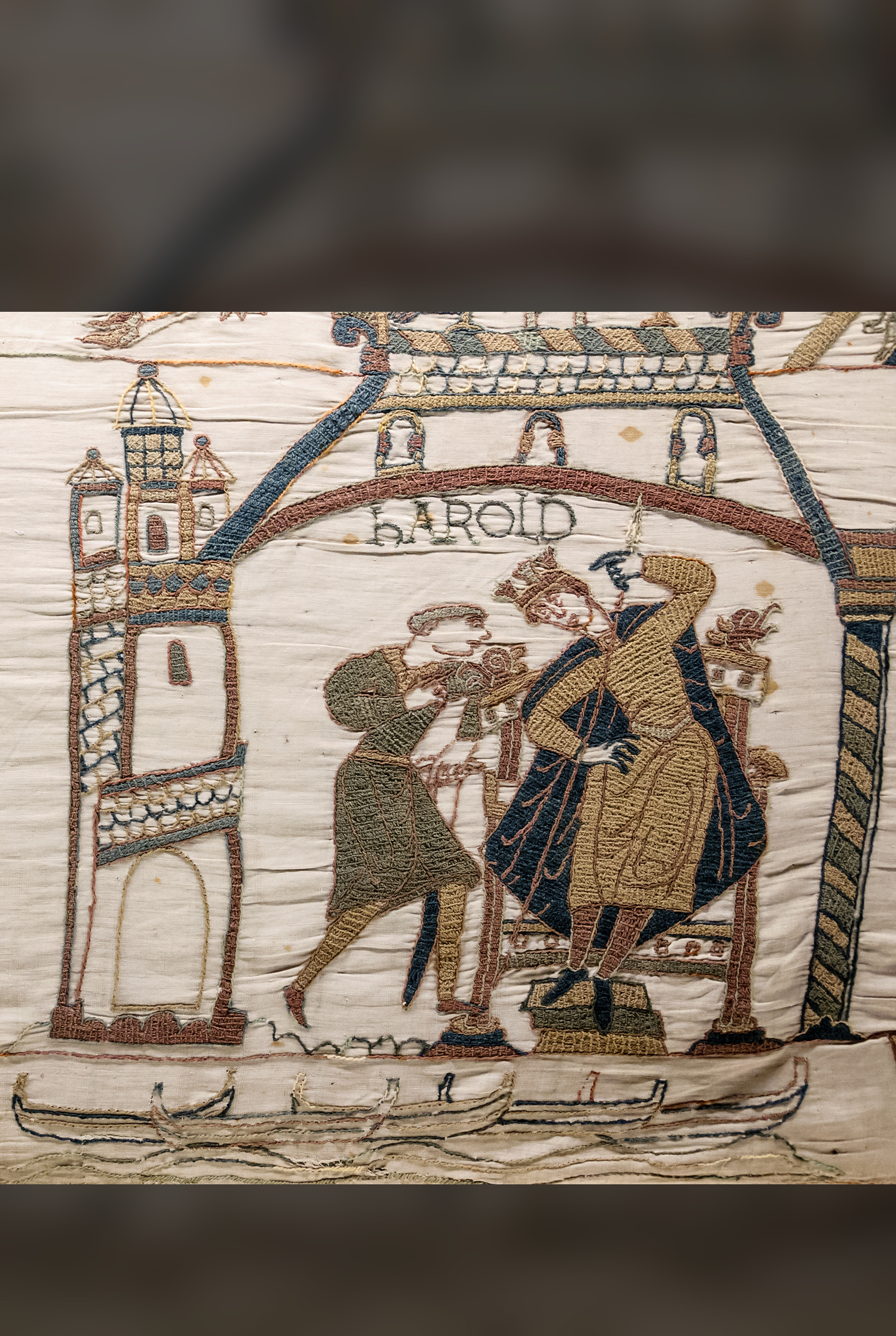
The comet is in the wrong place.
King Edward of England died on January 5, 1066. The next day, Harold Godwinson was crowned king.[^lewis] Duke William of Normandy, in northern France, claimed the English crown for himself, and he began building an invasion fleet.[^bm]
In the Tapestry, the comet shows up right after Harold’s crowning.[^bm] The real one didn’t arrive until spring. The Anglo-Saxon Chronicle, a year-by-year history of England written at the time, says it was first seen on April 24. The writer called it a “haired star” and said it shone all that week.[^lewis]
The makers already knew how the year ended.
On October 14, 1066, William’s army met Harold’s at the Battle of Hastings.[^bayeux] Harold died there, and on Christmas Day William was crowned king of England.[^bm][^bayeux]
So they set the comet right beside Harold, as a warning of his fall.[^lewis]
The Tapestry has decorated strips along its top and bottom edges, called borders. Look at the lower border under Harold as a man brings him news of the star. A fleet of empty ships sits there. They’re stitched in outline only, so they look see-through. British Museum curators think they may be a ghostly hint of the Norman ships to come.[^bm]
That reading came later, though. The earliest English records never tie the comet to the invasion.[^bm]
The monk who saw it twice

About 60 years after 1066, a monk named William of Malmesbury, who lived at Malmesbury Abbey in Wiltshire, England, wrote down a story about an older monk there. His name was Eilmer, and he is best known for something else entirely.[^lewis]
Eilmer once fixed wings to his hands and feet and tried to fly, like Daedalus, the inventor in a Greek myth who made wings. He crashed and broke his legs. According to William of Malmesbury, Eilmer blamed it on forgetting to fit a tail.[^lewis]
(Honestly, fair. Birds do have tails.)
Eilmer also said he had seen the comet once before. That was in 989, and he took it as a sign of disaster for England.[^bm] When it came back in 1066, William writes, the old monk crouched in terror and spoke to it: “You’ve come, have you?” Then he told the star it was bringing ruin to his homeland.[^lewis]
From 989 to 1066 is 77 years, so it’s possible.[^lewis] And William’s story already treats it as the same comet coming back, more than 500 years before Edmond Halley made the case.[^bm]
Older than the Tapestry
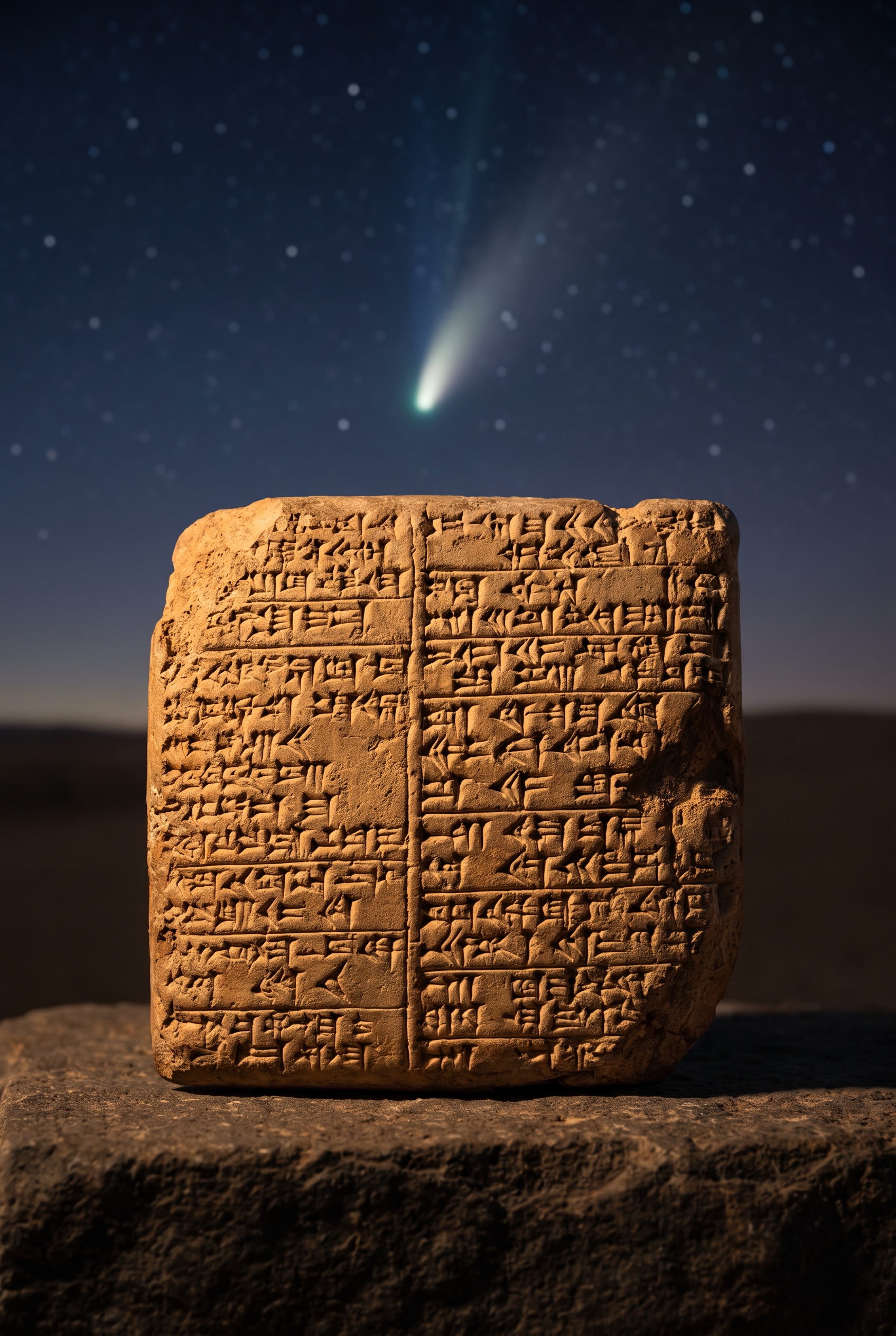
The comet has an even older witness. In the British Museum sits a clay tablet about 12 centimeters (5 inches) tall, roughly the size of a drink coaster. It’s a sky diary from ancient Babylon, in what is now Iraq, written in cuneiform, the wedge-shaped writing of the region.[^tablet]
The tablet dates from 164 BC. It records Halley’s Comet moving through the sky near the Pleiades, a small, bright cluster of stars.[^tablet] People have kept track of this comet for more than 2,000 years.[^nasahalley]
Working out that it was one comet coming back again and again took until 1705.
That year an English astronomer named Edmond Halley noticed something odd. The comets seen in 1531, 1607 and 1682 looked almost exactly alike. Same comet, he said. It’ll be back in 1758.[^schools]
He died in 1742, sixteen years too early to check.[^schools]
It showed up on Christmas Day 1758, right on schedule,[^schools] and it has carried his name ever since.[^lewis] (Not a bad way to be remembered.)
It travels a long loop around the Sun and comes back about every 76 years. It last came by in 1986, and it returns in 2061.[^nasahalley]
The comet’s crumbs fall every October

Halley’s Comet leaves a trail of dust and grit along its path. Twice a year, Earth passes through it. In May we get the Eta Aquariids. In October we get the Orionids.[^nasahalley]
Each speck hits our air at about 41 miles (66 kilometers) a second and burns up as a streak of light. A few flare into bright fireballs.[^orionids] (At that speed you could get from New York to Philadelphia in a little over two seconds.)
In 2026 the Orionids run from October 2 to November 7, and the best night is October 21 to 22. Go out after midnight, somewhere far from city and street lights. Under a dark sky you might see 10 to 20 an hour.[^orionids]
Lie back with your feet pointing southeast (northeast if you live south of the equator). The meteors seem to fly out from one spot near the constellation Orion, a point called the radiant. Don’t stare straight at it. Look a little to one side, and the streaks look longer.[^orionids]
That spot is how the shower got its name. The dust itself is Halley’s.[^orionids]
Take the comet home

The real thing isn’t back until 2061.[^nasahalley] Until then, here’s Halley’s Comet sized for your phone. Press and hold the picture (or right-click it) to save it as your wallpaper.
(It’s an artist’s impression. The comet hasn’t posed for a photo since 1986.)
Still looking up
The Bayeux Tapestry is in London now, at the British Museum, until July 11, 2027. The museum says it’s the first time the Tapestry has been back in England since it was made.[^bmexhibit]
Picture those stitched men once more, turning to point. In April 1066, nobody knew how the year would end. The people who stitched them did, and they gave the star its meaning.
People have always read messages in the sky. Now one can arrive every morning, written just for you.


Image credits: Bayeux Tapestry photos by Myrabella, via Wikimedia Commons (public domain). The comet scenes, the monk, the clay tablet and the night sky are artist’s impressions.
[^lewis]: Michael Lewis and Simon Portegies Zwart, The significance of Halley’s Comet in the Bayeux Tapestry (2025). [^bayeux]: Bayeux Museum, Discover the Bayeux Tapestry (2026). [^bayeuxonline]: Bayeux Museum, Explore the Bayeux Tapestry online (2026). [^bmexhibit]: British Museum, The Bayeux Tapestry (2026). [^nasahalley]: NASA, 1P/Halley (2026). [^bm]: Michael Lewis, Millie Horton-Insch and Sue Brunning, British Museum, Everything you need to know about the Bayeux Tapestry (2026). [^tablet]: British Museum, Clay tablet 41462: Babylonian astronomical diary, 164 BC. [^schools]: The Schools’ Observatory, Liverpool John Moores University, Edmond Halley. [^orionids]: NASA, Orionids (2026).