
The Guest Star: A Fable of 1054
This is a fable. The people in it are imagined, but the star was real, and so is what became of it. The true story is at the end.
The Guest Arrives at Dawn
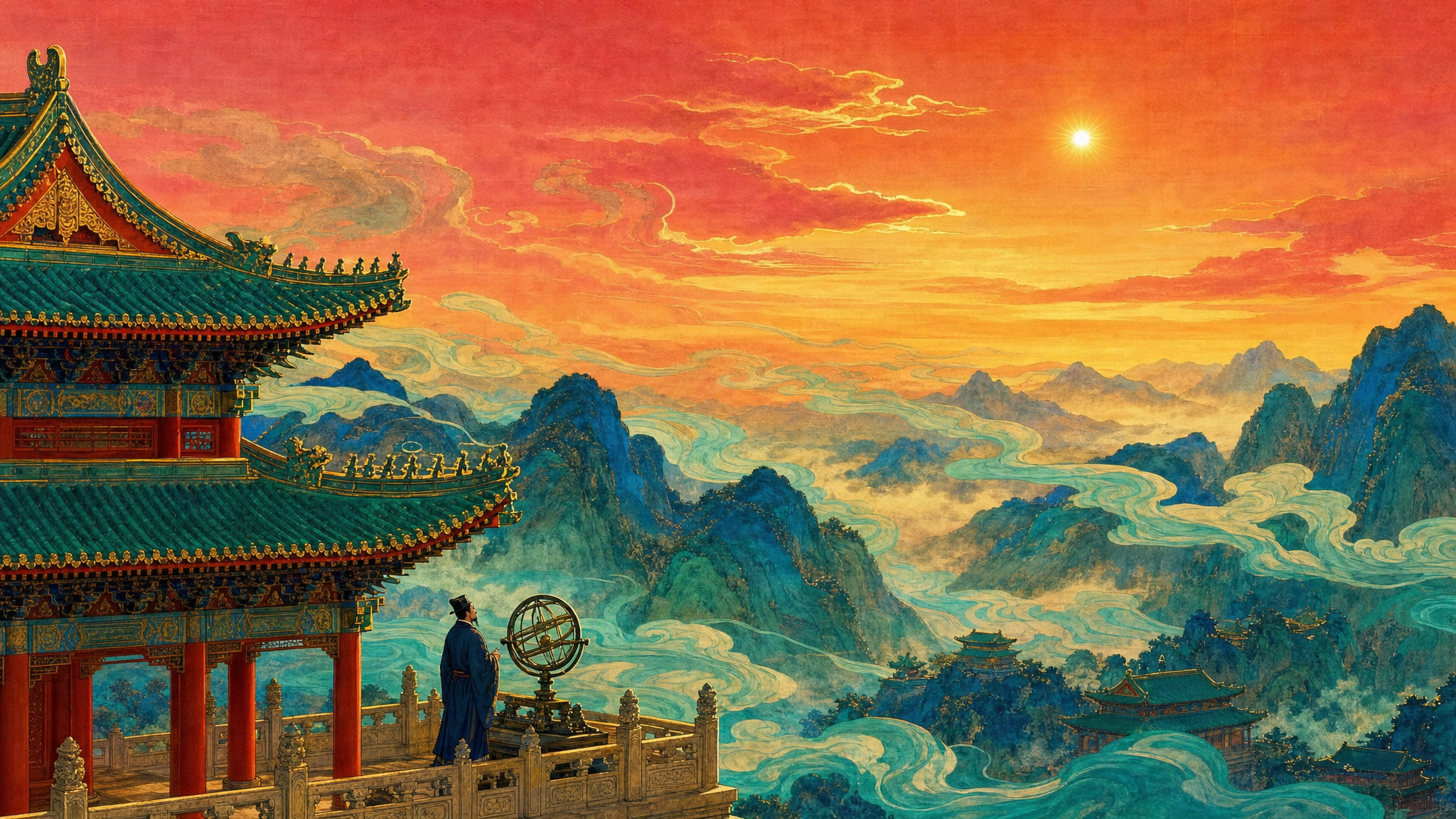
In the summer of 1054, a young astronomer kept watch on the palace terrace. In the east, the sky was turning from indigo to rose.
Low on the horizon, beside the star called the Celestial Gate, there was a light that had not been there the night before. The Celestial Gate is a star in what we now call Taurus, the Bull.
The new light was as bright as Venus. When the sun came up, it did not fade.
He ran to wake his master.
The old man came out in his sleeping robe and looked for a long time.
“A guest star,” he said. “It comes. It stays a while. Then it leaves.”
For twenty-three days, the guest shone even in daylight. After that, it could be seen only at night.
The Brush and the Bronze Rings

“Is it a warning?” the young astronomer asked. “A gift?”
The old man did not answer. He went to the armillary sphere on the terrace, a great frame of bronze rings that turned inside one another. Astronomers used it to measure where a star stood.
He turned the rings until they lined up with the guest. Then he sat at his desk and dipped his brush in ink.
Close to the Celestial Gate, he wrote, a little to the south-east. Then he added one more detail: just above the guest, a faint yellow shimmer.
“Why write where it is,” the young man asked, “and not what it means?”
“Write down where it stands,” said the old man. “What it means may change. Where it stands will not.”
The Emperor’s Question
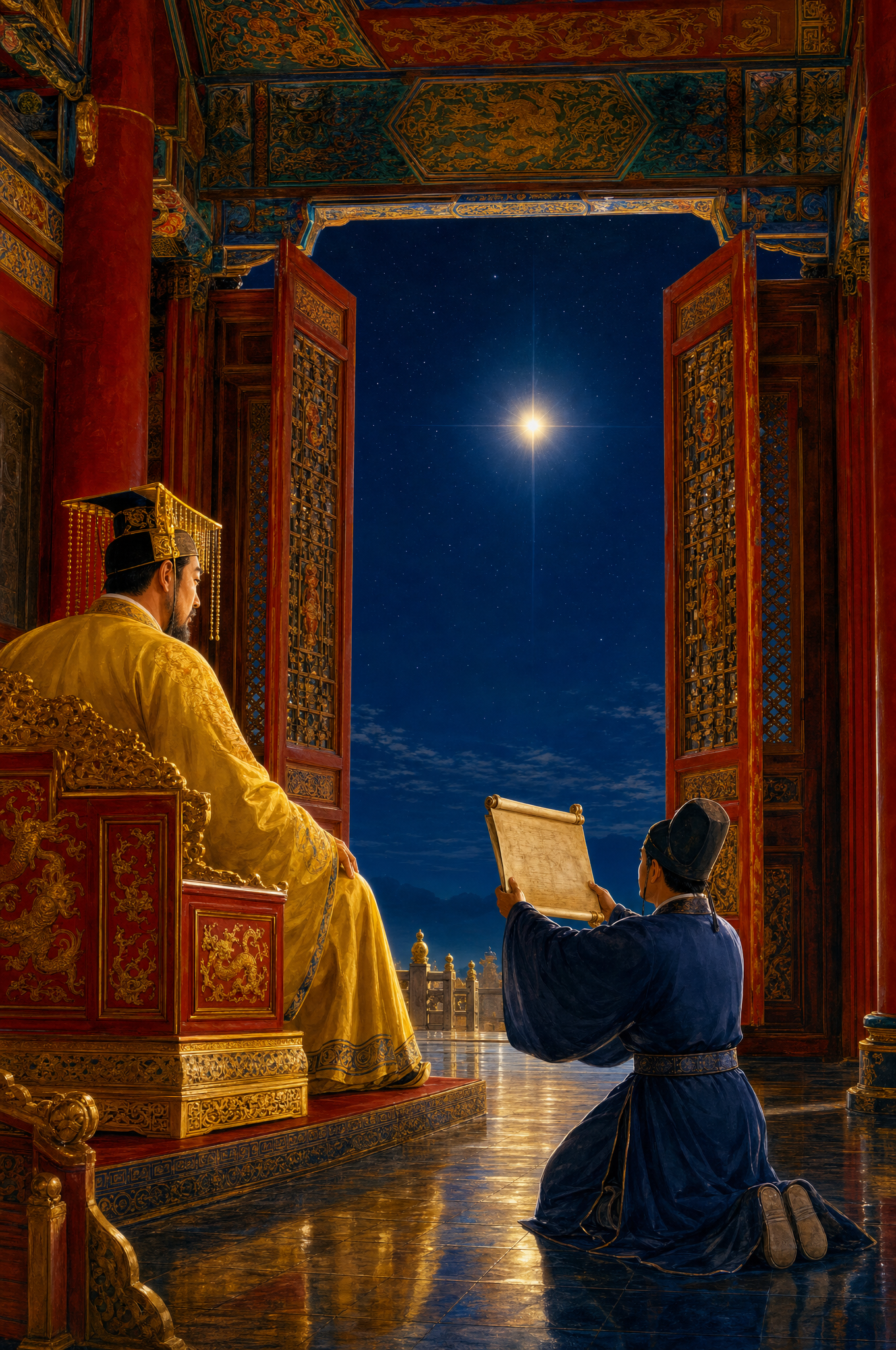
The emperor sat in a hall of red pillars and gold. “Is the guest a warning?” he asked.
The old astronomer knelt and opened the book of omens, the old rules for what the sky means for an emperor.
In the book, a guest that crossed into the Net, the group of stars beside it, was a bad sign. This one had stayed out, and its light was full and steady. “It is not a warning,” he said. “It means there is a person of great worth.”
Then he handed over his note and asked that the court historians copy it into the record.
Others Who Saw the Guest

Across the sea, on a summer night in Japan, the same guest shone over a palace pond. The sky-watchers there said it was as bright as Jupiter.
More than a hundred years later, a poet named Fujiwara no Teika copied their reports into his diary.
Far to the west, most likely in Constantinople, a doctor named Ibn Butlan wrote a short note about a new star. From Europe, no sure record has ever been found.
The Guest Departs
The guest stayed for almost two years. Each night it was a little dimmer.
In the spring of 1056, the astronomy office told the court it was gone.
The scroll with the old man’s note was rolled up, tied with red silk, and put on a shelf with all the others.
The note waited.
A Cloud Shaped Like a Crab
Almost seven hundred years later, in England, an astronomer named John Bevis pointed his telescope at Taurus and found a faint, cloudy smudge.
In 1758, Charles Messier found it too. He was hunting for a comet, and at first he thought this was it. But night after night, the smudge did not move. So he started a list of cloudy things that are not comets. The smudge became number one.
In the 1840s, Lord Rosse studied it through his big telescope at Birr Castle in Ireland. He drew it with long arms, like a crab.
The name stuck: the Crab Nebula. A nebula is a cloud of gas in space.
The Note Is Opened
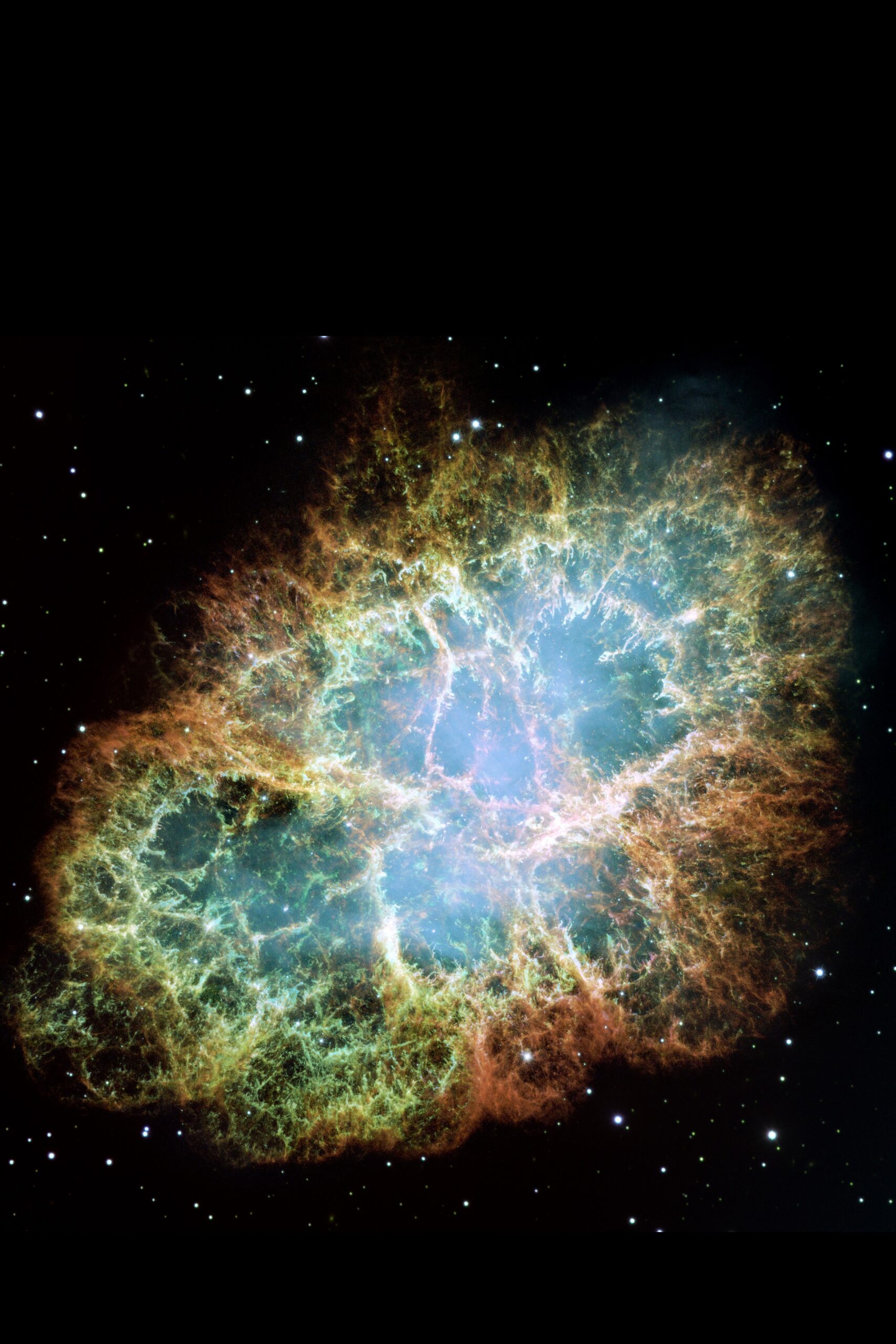
The Crab Nebula, photographed by the Hubble Space Telescope. Image: NASA, ESA, J. Hester and A. Loll (Arizona State University).
In the 1920s, astronomers noticed that the guest star in the old Chinese records had stood close to the Celestial Gate, near where the Crab sits today.
In 1942, a Dutch scholar named Duyvendak laid the Chinese and Japanese reports side by side, and the match was accepted.
The guest star had been a supernova, a star blowing itself apart. The Crab is the cloud it left behind.
At its heart is a pulsar, the crushed core of the old star. It spins about 30 times a second and sweeps out beams like a lighthouse.
The Crab is so far away that its light takes about 6,500 years to reach us. The star had blown apart thousands of years before the young astronomer looked up.
Still Watching
The old astronomer is long gone. His note is not.
People have always read messages in the sky. Now one arrives every morning, written just for you.


Behind the Fable
The young astronomer, his master, and the scenes on the terrace, in the throne hall and by the Japanese pond are imagined. The old man’s note stands for the real records: the official history of the Song dynasty and a report to the throne by the astronomer Yang Weide.
A guest star appeared at dawn on July 4, 1054, near the star Tianguan (Zeta Tauri), the Celestial Gate.[^sg][^zeta] Chinese astronomers saw it in daylight for about 23 days, compared it with Venus, and kept track of it until April 1056.[^sg] The official history places it south-east of Tianguan.[^wsn]
Yang Weide’s report, dated August 27, 1054, mentions a faint yellow glow above the star.[^wsn] It gives the omen reading too: the star had not crossed into the Net and its light was full, so it meant “a person of great worth.” He asked that the court historians be told.[^wsn]
Japanese records compared the star’s brightness with Jupiter, and the poet Fujiwara no Teika later passed on older reports of it in his diary, the Meigetsuki.[^sg][^kyoto] Ibn Butlan, a Christian doctor, most likely writing in Constantinople, noted a new star. No definite European record survives.[^sg]
John Bevis found the Crab in 1731, Charles Messier listed it in 1758, and Lord Rosse’s drawing in the 1840s gave it its name.[^nasa][^wcrab] Knut Lundmark (1921) and Edwin Hubble (1928) linked it to the guest star, J. J. L. Duyvendak gathered the records in 1942, and the pulsar was found in 1968.[^sg][^nasa]
[^sg]: F. Richard Stephenson and David A. Green, The Historical Supernovae (2003). [^wsn]: Wikipedia, SN 1054, and the translations and scholarship it cites. [^zeta]: Wikipedia, Zeta Tauri. [^kyoto]: Kyoto University, Meigetsuki and the Latest Images of Our Universe (2014). [^nasa]: NASA Science, Messier 1 (The Crab Nebula), Hubble Messier Catalog. [^wcrab]: Wikipedia, Crab Nebula, and the scholarship it cites.